Fleet intelligence today drives success in autonomous trucking tomorrow
Key takeaways
- Fleet-wide data and AI visibility improve maintenance, uptime, and operational efficiency, laying the groundwork for future autonomy.
- Real-time insights into trailer cargo, tire, and powertrain health help fleets move from reactive fixes to predictive maintenance.
- Creating a connected digital twin now enables safer, scalable autonomous operations and smoother integration of advanced technologies.
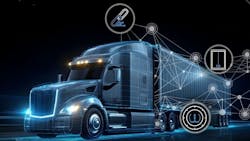
Autonomous trucking is moving beyond concept and into early commercialization, with real-world execution taking shape over the road and on property. While virtual driver technology delivers immediate operational value, performance at scale will be driven by intelligence across the ecosystem.
Preparing for scalable automation starts with building broader, deeper intelligence across the entire operation, from the back office to the combination vehicle. This intelligence is already delivering value by improving asset utilization, strengthening maintenance programs, and increasing overall reliability.
The same foundation that will support autonomy tomorrow is what reduces breakdowns, improves inspection outcomes, and drives disciplined fleet operations today. Fleets connecting systems that affect safety, uptime, utilization, and cargo integrity are building a practical path toward scalable automation.
In my experience working with fleets across North America, progress begins with a clear view of how tractors and trailers perform on the road and in the yard. Driver behavior, powertrain performance, tire and wheel health, cargo status, lighting, door security, and utilization all influence safety and reliability. Many fleets still manage these areas through yard checks, preventive maintenance intervals, and manual processes. While that approach has worked for years, it becomes harder to sustain as equipment grows more complex, costs rise, and customer expectations increase.
Technology continues to expand what fleets can see and act on beyond traditional telematics. Advanced sensors, cameras, and connected platforms now deliver real-time visibility into both powered vehicle and trailer health. When data is interpreted through AI and machine learning, fleets gain actionable insight into what matters, such as gradual tire pressure loss versus tire compromise, early brake wear and ABS faults, roll stability events, failed light circuits, and emerging wheel end failures.
Visibility into trailer cargo status equips operations with insights needed to make customer decisions. Knowing whether it is fully loaded, partially utilized, or empty, as well as its current position, helps reduce wasted time and miles while improving overall productivity. These insights allow maintenance teams, planners, and operations leaders to move from reacting to predicting and preventing issues, increasing overall fleet reliability and strengthening reputation.
Safety remains central to any future that includes higher levels of automation. Human drivers often detect signs of mechanical concern before a fault light appears or issues surface. They may smell overheating brakes, detect a vibration at wheel end, or hear unusual noises. In a combination vehicle, however, conditions behind the tractor are harder to detect. As the industry moves toward higher levels of autonomy, closing the gap between what a driver can sense and what the vehicle must understand on its own becomes increasingly critical.
Fleets are beginning to close that gap by bringing continuous vehicle and trailer data into the cab. Inputs across the vehicle and trailer systems deliver a unified, end-to-end view of the combination vehicle. That intelligence is what will enable automation to recognize and respond to conditions a driver may never sense. It ensures the right information reaches the right people across the organization, whether that is a local technician, dispatcher, corporate safety, or tomorrow’s autonomous command and control.
For fleets with an eye on the future, this shift is part of a broader operational evolution. It is not simply about adding sensors, but about creating a connected digital twin that learns from every trip and supports more confident data-informed decisions throughout the organization. Fleets that begin developing these capabilities now position themselves to integrate more advanced technologies with far less disruption over time.
Autonomous trucking will not arrive all at once, but it is advancing quickly. Scalable gains will result as operations rely on visibility, intelligence, and coordination across the ecosystem. Fleets that build this connected digital foundation today will be positioned to capitalize on the next generation of automation and AI-enabled freight movement. An autonomous operation is fully informed, and that journey begins with recognizing the value of data available today.
 Trucking industry poll: How should fleets respond to potential tariff refunds?
 fleet leader state of fleet management report
About the Author
 Lawrence Bader
Lawrence Bader
Lawrence Bader is a retired transportation technology executive with 32+ years at UPS, leading Global Fleet Systems. He is now focused on helping fleets adopt digital solutions, fostering industry collaboration, and guiding the transition to autonomous vehicles. Bader is active in industry associations and advisory groups on fleet digitization and automated operations.