Flexible in the face of hardship: Why the dedicated fleet model is meant for today
Key takeaways
- Dedicated contract carriage contracts stabilize rates and guarantee capacity in fluctuating freight markets.
- Dedicated fleet providers today are a key conduit of supply chain engineering practices providing shippers with state-of-the-art advantages.
- Modern dedicated fleet models are tailored solutions that supplement and augment other transportation programs.
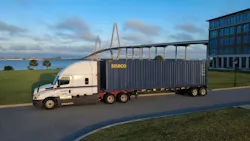
With today’s shifts in the freight market, regulatory changes, and increasing road risks, shippers are looking hard at longstanding transportation programs. Amid significant and rapidly changing conditions, dedicated fleets provide shippers with advantages that call the model into question.
Modern dedicated fleet model explained for fleets and shippers
Definitions of the dedicated fleet model vary. Ask 10 different shippers and expect to receive 10 different answers. Nevertheless, bedrock attributes include the following:
- An outsourced solution that operates as an extension of shippers’ operations
- Capacity is pre-established, not transactional.
- Shippers receive exclusive access to a set capacity of tractors, trailers, and drivers.
- Dedicated fleet management embeds with shippers’ transportation or supply chain.
- Established contracts and pricing are set for the long term, usually three or more years.
- All-in pricing includes insurance, maintenance, training, and other fixed costs.
- Safety and compliance programs are managed by the dedicated fleet provider.
These foundational features of dedicated contract carriage (DCC) provide attractive benefits to shippers who are wary of tightening capacity in the freight market and the mounting risks and costs of trucking today.
Additionally, much has evolved in the dedicated fleet model, particularly regarding its underappreciated advantages for shippers’ top priorities: customer service, costs, and control over equipment and drivers.
Common dedicated fleet misconceptions in trucking and logistics
Customer service-focused shippers naturally resist outsourcing a pivotal touchpoint to non-company drivers. But drivers in dedicated fleets who deliver on the same routes to regular customers are trusted brand ambassadors. They receive operational training, wear company uniforms, and drive branded trucks. Dedicated fleet drivers become an enduring bank of experience. Some TA Dedicated drivers stay with the same company for years, or even decades.
The inflexibility of dedicated fleet contracts is another misconception. This remains a stubborn objection among shippers today, especially those accustomed to the low rates readily obtained from one-way carriers in recent years. The problem is that the flexibility provided by short-term carrier contracts and load boards also puts shippers in a bind when capacity tightens, and rates rise as they are right now.
In contrast, dedicated fleets offer stable rates and guaranteed capacity. That set capacity is sometimes misconstrued as set in concrete, but dedicated fleets enable easy scaling to meet volume spikes. Vetted drivers and equipment from a dedicated fleet provider’s wider fleet can be deployed to absorb spikes or redeployed elsewhere in the provider’s network during slack periods.
Another misconception is that the dedicated fleet model is an inflexible all-or-nothing solution. Dedicated fleets today augment and supplement private fleets and mixed transportation models to fit shippers’ needs.
Recently, TA Dedicated deployed a dedicated fleet for a large manufacturing client to deliver exclusively to select high-value retail clients. Their prior solution of using one-way carriers delivered 95-96% on-time performance, but the risk of that performance dropping to 85-90% amid today’s market instability was too great. A dedicated fleet provides premium service with 98%-plus on-time performance that the customer needs to protect their high-value clients.
Lost business costs shippers, so do damage claims and chargebacks from late deliveries. DCC helps control these costs and more. With DCC, the considerable costs of everything from training and compliance to engineering and technology are absorbed by dedicated fleet contracts, providing value below the surface.
 Why dedicated transportation models reduce fuel risk and improve fleet stability
 DCC
DCCDedicated contract carriage (DCC) stabilizes rates and capacity constraints
The guaranteed capacity and stable rates of DCC provide distinct benefits as capacity tightens and rates rise. We’re seeing this play out right now.
Since March 2025, the van-load-to-truck ratio has almost doubled to 9.14 loads per truck, per DAT. On top of that, carrier rejections have risen steadily in 2026. In addition to capacity constriction, linehaul spot rates for dry van have risen 21% since March 2025, per DAT.
These increases don’t look to be short-lived either. The non-renewal of non-domiciled CDLs and increased enforcement of English-language proficiency requirements could remove 200,000 drivers from the market in the coming months.
A dedicated fleet provider can serve as a shock absorber for shippers seeking capacity in a market where the number of carriers continues to decline. And with mounting rates, DCC offers budget protection for the length of the contract, usually 3-5 years.
Dedicated fleets deliver agility for shippers facing market volatility
Things are changing fast in trucking, and shippers can’t just set it and forget it when it comes to their supply chains. That reality has elevated the role of supply chain engineering (SCE). Modern dedicated fleet providers give shippers the upper hand by integrating SCE into their comprehensive services.
Tariff shifts and a host of port- or weather-related disruptions are only part of the challenges that require quick pivots. Continuous optimizations through advanced SCE have tremendous potential to improve efficiency, cut costs, circumvent delays, and extend shipment visibility.
SCE has become an essential function for leading DCC providers, heightening responsiveness by tightly integrating it with fleet and customer operations.
Dedicated fleets’ practice of embedding management in customers’ operations enables them to function as an extension of shippers’ supply chains. In addition to getting freight from A to B, dedicated fleet providers supplement and augment shippers’ expertise with trucking strategy and an experienced outsider’s insights into network changes, volume shifts, supply chain strategies, and their impact on transportation.
Outsourcing trucking operations reduces safety, cost, and liability risks
There are constant reminders today of the risks involved with trucking and its potential impact on shippers. In March this year, a jury awarded $81 million to plaintiffs impacted by a truck crash in Utah, making it one of the largest trucking-related nuclear verdicts in history.
The need for safety and compliance programs in fleets is clear, but the investment in training and safety technology is considerable. In many small fleets, the role of safety officer is often one of many hats worn by one employee. As a result, compliance slips and training lapses occur.
Safety training is a key function performed by dedicated fleet providers with established processes and expertise. The benefit of safety training provided as part of a dedicated fleet program can be dramatic.
For the world’s largest provider of end-to-end wire and cable management solutions, TA Dedicated created a driver training program to teach safe and proper loading of the company’s fragile and hazardous freight. As a result, the regular incidence of accidents and damage claims before the program was reduced to zero for the six months following the program.
Dedicated fleets offer safety advantages for equipment. Trucks are often newer. The average age of TA Dedicated’s trucks, for example, is 2-1/2 years. The latest equipment provides shippers with the latest safety technology, such as onboard cameras, collision mitigation systems, active speed intervention, and electronic stability control.
Safety and compliance advantages of modern dedicated fleet programs
With today's risks and market pressures, shippers need new solutions.
Through DCC, shippers can safely outsource the parts of their transportation program with the most demanding service requirements. They can take advantage of previously unattainable efficiencies thanks to SCE technology. And depending on the dedicated fleet provider, they can do so by leveraging safety and compliance programs that mitigate the staggering road risks of today.
Now’s the time to put misconceptions about DCC aside, starting with the one that launching is a laborious process.
With implementations averaging 90-120 days, a dedicated fleet is more doable than many shippers know.
About the Author
 Rob McNeil
Rob McNeil
Rob McNeil is the SVP of commercial & supply chain solutions at TA Dedicated, located in Eagan, Minnesota. TA Dedicated is a division within TFI International (TFII) and delivers dedicated truckload services through its more than 1,000 dedicated drivers and expansive fleet of dry van, flatbed, tanker, and straight trucks. With nearly 30 years of industry experience, Rob’s passion is creating transportation solutions for customers that deliver value to their supply chain while helping them win with their own customers.