The trailer is starting to pull its own weight
Key takeaways
- Trailer electrification is expanding beyond refrigeration into broader fleet energy management.
- Electric axles, batteries, regenerative braking, and solar generation could reduce diesel use and operating costs.
- Connected trailers may eventually support fleet energy resilience and other power needs.
For more than a century, the relationship between trucks and trailers has remained remarkably consistent. The truck provided the power, intelligence, and performance, while the trailer carried the load. Before motorized transport, the horse provided the capability required to move goods, while the cart provided capacity. When trucks replaced horses, they inherited that role.
That distinction shaped how fleets evaluated trailers for generations. Operators bought them for the capacity they provided: payload, volume, durability, and reliability. Those attributes remain critical, but a new set of considerations is emerging. Operators increasingly evaluate what a trailer can do, not just what it can carry. Advances in electrification, energy management, and connectivity are enabling the trailer to contribute directly to the efficiency and cost of the journey.
Refrigerated transportation provides one of the clearest examples of this transition. For years, discussions around electrified refrigeration centered on a single question: Could operators move away from diesel-powered transport refrigeration units without compromising performance?
Battery-powered refrigeration systems already show that operators can reduce diesel consumption, lower maintenance requirements, and support broader sustainability objectives while maintaining the performance demanded by modern cold chain operations. What was once viewed as an emerging technology is steadily becoming part of day-to-day transport operations. Solutions available today show that the transition can be achieved without disrupting existing operations or compromising reliability.
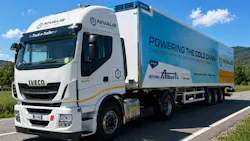
The same principles that allow a refrigerated trailer to generate, store, and intelligently manage energy can be applied far beyond refrigeration itself. This thinking underpins a growing number of trailer electrification projects emerging across the industry. One recent example is a pilot project involving us (Nivalis Energy Systems), TIP Group, BPW, and German transport operator Sommer.
 adobestock_1781531039
The project evaluates a propelled semi-trailer operating under real-world logistics conditions, using an electric axle, onboard battery storage, regenerative braking, and roof-mounted solar generation. With significant rooftop space available for solar generation, the trailer itself becomes part of the energy solution. Together, these technologies enable the trailer to recover, store, and redeploy energy that would otherwise be lost during normal transport operations.
While the projected savings of up to 7,000 liters of diesel per trailer per year will understandably attract attention, the project's broader significance arguably lies elsewhere. The ability to generate, store, and intelligently manage energy opens up possibilities that extend well beyond propulsion alone. Today, that energy is helping move the load. In the future, the same energy could potentially support fleet sites, improve energy resilience, or even be supplied back to the grid. In a very real sense, the trailer is starting to pull its own weight.
This represents a fundamental shift in how trailers are valued. Historically, operators bought trailers for the capacity they provided. Today, they’re increasingly asking whether an asset can reduce fuel consumption, lower operating costs, support sustainability goals, and improve overall fleet performance.
This transition extends far beyond electrified refrigeration alone. The industry has only just begun to scratch the surface of what the trailer can become—creating entirely new opportunities for fleet owners.
As fleets continue to electrify, the ability to generate, store, and deploy energy may become just as valuable as the ability to move goods. Driven by everything from transport electrification to AI, data centers, temperature-controlled warehouses (cold storage) in food and pharma—and increasingly connected industries—electricity demand continues to rise, and the ability to generate, store, and intelligently manage energy is becoming increasingly more important.
As technologies such as vehicle-to-grid (V2G, V2L, or V2H) integration matures, we believe it will create opportunities for trailers to support fleet site energy resilience and wider grid capacity. At sufficient scale, fleets of connected trailers could collectively store and supply significant amounts of energy, raising an intriguing possibility: Could the trailer of the future become a new and valuable profit center, contributing not only to the movement of goods but also to the wider energy needs of the businesses and communities it serves?
This is where the conversation moves beyond electrification and sustainability. While both remain important, the bigger opportunity may be creating a more efficient, intelligent, and energy-aware transport ecosystem—essentially, the trailer becoming a strategic energy asset.
Today's technologies already show that trailers can contribute far more to transport operations than carrying cargo alone. The question now is which operators, fleets, and logistics providers act first to claim what could become a huge competitive advantage.
About the Author
 Sam Plunkett
Sam Plunkett
Sam Plunkett is CEO of Nivalis Energy Systems, where he is leading the transition away from diesel-powered refrigeration in commercial transport. Under his leadership, Nivalis is developing and deploying electrified refrigerated trailer solutions that help fleets reduce operating costs, lower emissions, and improve the efficiency of cold-chain logistics operations across North America and Europe.