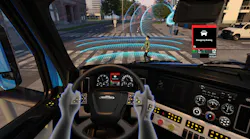
Safety systems move into the mainstream
Key takeaways
- Integrated safety systems can help fleets reduce crash risks and improve driver protection.
- Collision prevention technology may help fleets address litigation exposure from serious crashes.
- Cameras, radar, and roadside warning systems can help drivers identify hazards and respond sooner.
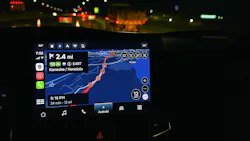
For fleets operating in today’s difficult litigation environment, preventing crashes is only part of the safety equation. They must also be prepared to show what happened—and demonstrate that they took reasonable steps to keep it from happening—in a court of law.
Nuclear verdicts—jury awards large enough to threaten a fleet’s financial survival—have changed the calculation around safety investments. Technologies once regarded as expensive options are increasingly viewed as tools to protect drivers, control accident costs, and strengthen a fleet’s position when litigation follows a crash.
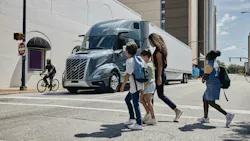
“Customers are looking for solutions that help protect their drivers while making their businesses stronger,” Maddie Sullivan, product marketing manager for Volvo Trucks North America (VTNA), said. “Integrated safety systems can help reduce risk, support uptime, and potentially lower accident-related costs, which is why these technologies are increasingly becoming a core requirement for fleets today.”
“Integrated” is the key word. Today’s safety technologies increasingly combine cameras, radar, electronic braking, steering controls, and vehicle data to create multiple layers of protection around a truck. Some warn drivers of danger. Others intervene automatically when a collision or loss of control appears imminent, and telematics and video systems can then preserve a record of what occurred.
That evidence can be invaluable when a passenger vehicle cuts closely in front of a truck, forcing the driver into an impossible situation. But the technology can cut both ways. Data showing that a fleet ignored repeated warnings, failed to coach a driver, or neglected system maintenance can be damaging in court. Installing the equipment is only the first step. Fleets must act on the information it provides and document those actions.
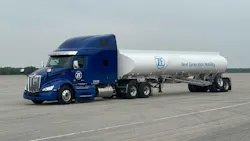
Dirk Wohltmann, a senior engineering leader at ZF, said advanced safety systems can help fill the momentary gaps in attention every human experiences during a long, demanding driving day.
“These technologies really help to prevent these accidents,” he said. “And every accident we can prevent is one less kind of verdict.”
The same safety philosophy is moving beyond trucks traveling at highway speed. Emergency Safety Solutions (ESS) is addressing collisions involving commercial vehicles stopped along the roadside, where conventional hazard lights and warning triangles may not give approaching drivers enough time to react.
“One of the most significant and underreported problems on our roads is collisions with stopped or disabled trucks,” David Tucker, CEO of ESS, said. “This is a very costly and deadly problem that happens dozens of times every day and often leads to significant litigation for drivers, owners, and fleets.”
ESS is integrating its Advance Warning Solutions into fleets to alert approaching traffic farther upstream, encouraging motorists to slow down and move over before reaching the disabled vehicle.

 Roadside tire service safety: How fleets can reduce technician accidents
Layers of protection
No single safety system can prevent every crash. But several technologies working together can reduce the chances of a crash—or lessen the consequences when one cannot be avoided.
Here are the top Class 8 vehicle safety systems available today, along with the benefits they offer both drivers and fleets.
- Rearview cameras: Rear-facing cameras give drivers a clearer view behind the vehicle while backing or maneuvering in tight spaces. Other camera-monitor systems supplement or replace exterior mirrors, reducing traditional blind areas while giving drivers a better view down the sides of the tractor and trailer. Depending on the system, cameras may also improve nighttime visibility and help drivers see through rain and road spray. Recorded video can provide critical context after an incident.
- Adaptive cruise control: Conventional cruise control maintains a selected road speed. Adaptive cruise control uses forward-looking radar, and sometimes cameras, to monitor traffic ahead and maintain a preset following distance. The system can reduce throttle, apply engine braking, or activate the service brakes as traffic slows. It reduces some of the repetitive workload associated with constantly adjusting speed, but it does not relieve the driver of responsibility for controlling the truck.
- Collision mitigation: Forward-collision mitigation systems continually assess closing speed and distance to vehicles or objects ahead. When a rear-end collision appears likely, the system first warns the driver. If the driver does not respond quickly enough, it can automatically apply the brakes. Sensor condition, weather, road geometry, and how suddenly a hazard enters the truck’s path can affect performance. But even when automatic braking cannot prevent a crash, reducing impact speed can make an enormous difference in accident severity.
- Blind-spot warnings: Radar, ultrasonic sensors, and cameras can monitor areas alongside the tractor and trailer that are difficult for the driver to see. Visual or audible alerts warn when another vehicle, cyclist, or pedestrian occupies a monitored zone—particularly during lane changes and right turns. More advanced systems can escalate their warnings or intervene if the driver continues moving toward the detected hazard.
- Anti-rollover systems: Electronic stability control on the tractor monitors factors such as steering input, wheel speed, lateral acceleration, and vehicle direction. If the truck begins to deviate from the driver’s intended path or approaches a rollover threshold, the system can reduce engine torque and selectively apply brakes.
Trailer roll-stability systems provide another layer of protection by monitoring trailer dynamics and applying trailer brakes when rollover conditions develop. That response can be crucial during an emergency maneuver, when a driver may not recognize the developing instability until it is too late.
Together, these technologies represent a fundamental shift in truck safety. They cannot eliminate human error, unpredictable motorists, or the physical limits of a loaded combination vehicle, but they can see hazards the driver cannot, react during a critical fraction of a second, and document what really happened.
In an era of escalating accident costs and nuclear verdicts, those capabilities are quickly becoming less of an option—and more of a basic requirement for fleets today.
About the Author
 Jack Roberts
With almost three decades covering trucking, Jack Roberts is known for reporting on fleet technology, such as intelligent drivetrains and autonomous vehicles, in an industry being transformed by technology. As a commercial driver’s license holder, he also test-drives new equipment and covers topics such as maintenance, fuel economy, vocational and medium-duty trucks, and tires.