Optimizing trucking operations: Strategies to save time and boost efficiency
Key takeaways
- Staying the course and concentrating on controllable factors like time management are essential for navigating industry difficulties effectively.
- Weigh station bypass services can save drivers the time it takes to stop, reducing fuel consumption, HOS violations, and operational costs significantly.
- Implementing reserved parking and parking clubs helps decrease circuity, driver turnover, and safety hazards, leading to substantial time and cost savings.
Regulations, the economy, and the high cost of insurance are just a few of the industry’s top challenges, according to the annual critical issues survey from the American Transportation Research Institute (ATRI). While these issues warrant concern, they are largely beyond the control of fleet leaders.
To get through these tough times, American Trucking Association’s President and CEO Chris Spear offered a word of advice: “Stay the course.” The best way to do that is simply to focus on the metrics that are within your control—one of those metrics being time.
“Time is money,” as they say, and it’s also something that, once it’s gone, we’ll never get back. Unfortunately, this precious commodity is often wasted in the trucking industry.
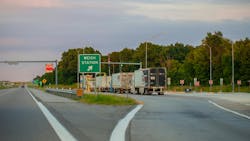
Take weigh stations, for example. These necessary and law-required stops strip precious time from your drivers. A weigh station stop costs drivers an average of three to five minutes, according to weigh station bypass service PrePass. Yet during times of heavy congestion, that wait time can be much longer. Multiply a three- to five-minute stop across every truck in your organization traveling interstate highways over the course of a day, and the hours add up quickly.
Then there’s the persistent lack of truck parking that keeps drivers circling travel center lots night after night. The issue of truck parking has been a top concern among drivers year after year, reflected in ATRI’s annual survey. This year, drivers ranked parking as their second-highest concern, behind compensation, and it ranked No. 4 overall.
While the industry’s problems appear to grow larger with each passing year, companies that support the industry—and the technology that enables them—are getting smarter. And eliminating wasted time is easier with technology built for that purpose.
Cut weigh station delays with bypass technology that protects HOS and fuel spend
The law requires any commercial vehicle weighing more than 10,000 lb. to stop at weigh stations. While the average weigh station visit takes three to five minutes, if a driver is pulled for a Department of Transportation (DOT) inspection, the stop could take longer. Because time is money, every second spent at a weigh station cuts into the bottom line.
As drivers idle in the queue to be weighed, they are wasting fuel—a half gallon, on average, according to PrePass. Further, each second that passes counts as on-duty time and reduces the driver’s eligible hours of service (HOS).
Fleet leaders looking for a solution to combat the time wasted at weigh stations could consider a weigh station bypass service.
Rob Abbott, Fleetworthy VP of customer success, explained how a bypass service like PrePass or Drivewyze by Fleetworthy works: Once trucks equipped with a bypass solution travel over weigh-in-motion scales on main highways and ramps, their DOT number and ELD information—including weight—are broadcast to the upcoming weigh station via the ELD modem, Abbott told FleetOwner.
“It broadcasts to the station, ‘Here’s my DOT number, here’s my registration, here’s my weight that just came off your [scales]. Do I even need to pull in?’ And the answer is usually ‘No,’” Abbott said. “Then on the electronic logging device, the driver gets a big green screen that says, ‘Bypass.’”
Once the driver has received confirmation from the weigh station, they can be on their way without stopping, saving them time, fuel, and their HOS.
"Nobody likes to sit there, pull in, and wait in that line only to be told you can keep going,” Abbott said.
In just one quarter, a Fleetworthy customer with 500 trucks accumulated more than 25,000 bypasses, Abbott shared, saving roughly 12,800 gallons of fuel, 3,100 hours of HOS time, and 131 metric tons of CO2. “This equates to a total savings of $284,000,” Abbott said.
If each quarter accumulated similar numbers, a fleet of that size could see potential savings of $1.1 million annually.
 truckload economy concept
Improve driver productivity and retention with reserved truck parking solutions
Another way fleet leaders can increase driver efficiency is by joining a parking club or using reserved parking services. These services, such as Truck Parking Club and Prime Parking from Pilot travel stations, provide guaranteed parking spaces for truck drivers.
While drivers or fleet owners must pay for these services, Brent Hutto, chief relationship officer at Truck Parking Club, told FleetOwner that fleets typically see a major return on investment.
“Think about it in three terms,” Hutto told FleetOwner. "What does [the lack of truck parking] cost [fleets] in driver turnover? What does it cost them in circuity—in other words, how long does the driver have to drive around to find a place? And then what does it cost them in hours of service that the driver is not driving because they are panicked because they can't let their ELD hours run out, and they park short of their hours?”
Reserved truck parking has become a game-changer for the driving experience, Reed Loustalot, Truck Parking Club chief marketing officer, said, citing a conversation he had with a driver who chose to pay for the service out of his own pocket because of its benefits. But because of its easy-to-use platform, it’s saved fleet managers and dispatchers hours of planning as well.
“We're saving fleet managers hours a day because all they're doing now is going into our app and booking parking for the driver. It's all automated,” Evan Shelley, Truck Parking Club co-founder and CEO, said, referring to the platform’s ability to seamlessly provide billing and reports for every fleet driver within a fleet.
What does this time savings equate to? To get a realistic idea, the team at Truck Parking Club surveys its driver and fleet leader members regularly. In one driver survey, the team sought to understand how much time and fuel drivers save by using the club services. The average answer was $13, and Shelley stressed that this baker’s dozen of cash saved is on top of the cost of the parking.
“Let's say they paid $20 for the parking,” Shelley explained. “They're saying they got $33 in value from it by not having to drive all around.”
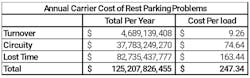
And that’s just from the drivers’ perspective. When looking from a macro view, Hutto said the savings are even more. According to a case study from freight consulting firm Transport Futures, the cost of turnover attributed to a lack of truck parking equates to roughly $10 per load. The cost of circuity—lost labor and wasted fuel—equates to roughly $75 per load. Finally, the wasted time equates to roughly $164 per load. Adding these numbers together, the industry wastes a total of about $125 billion in the quest to find parking annually.
Reserved parking helps keep drivers and freight safe by avoiding hazards associated with unauthorized zone or roadside parking.
With all the challenges fleet leaders face today, it’s easy to be swept up in the chaos. Yet, as ATA’s Spear advised, staying the course is key to navigating these trying times. And that starts with addressing what we can control.
About the Author
 Jade Brasher
Jade Brasher
Executive Editor Jade Brasher has covered vocational trucking and fleets since 2018. A graduate of The University of Alabama with a degree in journalism, Jade enjoys telling stories about the people behind the wheel and the intricate processes of the ever-evolving trucking industry.