As ZEV adoption cools, truck OEMs look to autonomous and GenAI
Key takeaways
- Zero-emission truck sales are expected to reach only about 13% in the U.S. by 2035, significantly lower than earlier predictions.
- Autonomous trucks are progressing steadily: McKinsey forecasts full autonomy by 2040.
- OEMs are showing interest in using generative AI to optimize operations across the value chain.
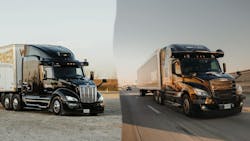
Trucking’s green transition is slowing, while its digital transition is accelerating.
Zero-emission truck sales are now projected to be significantly weaker over the next decade, though autonomous and AI adoption among OEMs is expected to maintain a strong pace, according to a recent presentation from McKinsey & Company partners to industry media.
“2025 was extremely challenging, and 2026 is projected to at least start equally challenging, hopefully to recover towards the tail end of it.” Moritz Rittstieg, partner with McKinsey & Company, told industry journalists. “This is tough times for OEMs, particularly with severe hits to profitability but also volumes. The question then becomes: How does the future look in the time where OEMs are generally in a pinch to invest toward future technologies?”
While demand for electric trucks has cooled, McKinsey’s experts see a steady march toward highway autonomy and the integration of AI into manufacturers’ operations, despite the technologies' investment requirements.
Electric truck adoption expectations plummeted
With a second Trump term, expectations for electric truck adoption weakened significantly in the U.S.
“The general sentiment is it has cooled; the timeline has shifted to the right,” Rittstieg said. “The order books have plummeted, and it looks like electrification is going to be significantly slower than initially projected.”
McKinsey now projects that zero-emission heavy- and medium-duty truck sales would likely reach about 13% in the U.S. by 2035. Over a year ago, McKinsey’s pre-Trump prediction had estimated over 35% by 2035.
For comparison, predicted zero-emission truck sales in Europe would be near 56%, and sales in China could reach 62% by 2035.
A major reason for the drop in ZE truck orders was when California lost its authority to mandate ZE truck sales. CARB states would have used the authority to require roughly 100% ZE truck sales by 2035.
Outside of specific, practical use cases like yard tractors, last-mile delivery, and school buses, ZE truck adoption ultimately “seems a ways out—and not moving forward without regulation that’s demanding it,” Rittstieg said.
Autonomous truck deployment remains strong
A much clearer use case for long-haul trucking today lies in autonomous technology.
“If there is positive, I’d say there’s positive in autonomy,” Rittstieg said. “The engineering problem is largely solved. There are questions that remain around how the value capture will shake out between the technology-providing startups, the OEMs, and the motor carriers.”
The technology providers, OEMs, and carriers will all need to benefit from the value that self-driving trucks offer. Each of the parties will also need to share the responsibility of investing in autonomous truck deployments. These remaining issues could be a significant factor in how autonomous trucks roll out in the coming years.
“The real question is, can the economics be good enough for fleets to take the risk? Somebody has to put up the money,” Rittstieg said. “The economics need to be good enough for someone to take the risk for this to really scale … With the tech upcharge and so on, you’ll get a benefit by taking the driver out—but it’s not going to be that significant.”
Autonomous trucks are already reaching steady deployment milestones in controlled environments. A small number of commercial routes, focused on controlled environments in the south of the U.S., are rolling in, Rittstieg said, with even more scaling in the years to come.
McKinsey’s partners forecast that autonomous trucks will operate in a “constrained autonomy” operation from 2027 to 2040. This constrained autonomy is the hub-to-hub model, where autonomous drivers move loads on highways between transfer hubs, and human drivers move loads from the transfer hubs to their destinations.
Gradually, however, they predict operations will reach full autonomy around 2040: Self-driving trucks would be able to bring loads directly from their origin center to their destination, with no interim transfer hubs.
According to a recent survey conducted by the McKinsey Center for Future Mobility, leaders in the autonomous-driving industry expect to deploy early Level 4 on-highway, hub-to-hub autonomous truck operations in 2029. Autonomous leaders expect full-journey driverless hauls by 2032.
Similar to zero-emission trucks, those timelines were farther out than McKinsey’s previous autonomous surveys had predicted. However, AV adoption does not depend as highly on regulation-driven demand, and many states allow autonomous trucks.
“Most of the states, to the tune of two-thirds of the states, are favorable [of AV trucks], a bunch of them are neutral, and very few of them are against it,” Rittstieg said.
Generative AI to boost truck development, sales
Truck makers are also beginning to focus on the benefits of generative AI. Rittstieg said that OEMs are particularly excited about how large language models (LLMs) could automate busy processes like software development, testing, spend analysis, contract management, and marketing.
“We see a high impact on commercial vehicles in terms of what value can be captured, whether it’s R&D, product development, software development, testing, validation, and so on,” Tobias Schneiderbauer, a partner with McKinsey & Company, said. “But it’s also across the whole value chain.”
In dealerships, for example, LLMs could support operations all the way from marketing to sales to customer service.
“If you really do it end-to-end, you can have a lead engine,” Schneiderbauer said. “Customer XYZ is potentially up for a new commercial Class 8 truck. He might be interested in the following configuration, and his past configuration was the following. And then you can directly also follow up with the right sales pitch and even with a differentiation versus a competitor. I think this becomes specifically relevant now, in times where we have less and less people in dealerships.”
 GM's logo at Hudson's Detroit
 Penske Logistics location
About the Author
 Jeremy Wolfe
Jeremy Wolfe
Editor
Editor Jeremy Wolfe joined the FleetOwner team in February 2024. He graduated from the University of Wisconsin-Stevens Point with majors in English and Philosophy. He previously served as Editor for Endeavor Business Media's Water Group publications.