Autonomous notes: Aurora sees ’27 revenues jumping 150% versus late this year
Key takeaways
- Aurora expects autonomous truck deployments to grow sharply as it moves toward positive cash flow.
- Kodiak is shifting its focus toward long-haul autonomy as customer testing and validation progress.
- Volvo and Waabi are testing autonomous freight operations on the Dallas-Houston corridor.
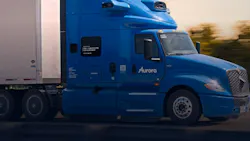
Aurora Innovation’s finance chief recently told investors the autonomous trucking venture is at a “commercial inflection point” that could propel the company to more than $5 billion in revenue just a few years from now.
Before then, though, comes 2027 and more measured expectations. Speaking at Evercore ISI’s 9th Annual ADAS, AV & AI Forum late last month, CFO David Maday provided more details about the outlook that Aurora executives led by Chairman and CEO Chris Urmson had shared at an investor day a few days earlier. The short-term target: $200 million in 2027 revenues, which would be a 150% jump from the $80 million run rate at which Aurora’s leaders expect to end this year—as well as some 100 times the company’s second-quarter sales.
That top-line growth will include Aurora’s fleet going from about 200 trucks late this year to 1,000 by the end of 2027 thanks to a customer base that includes notable names such as Hirschbach, McLane, and Schneider. On the way to Aurora hitting that mark, Maday told the Evercore audience that its gross margins will turn positive and it should soon after hit another financial landmark.
“In 2028, we continue to expect that we will achieve positive cash flow on a run-rate basis,” Maday said. “All the enablers are in place to support this.”
And that $5 billion target? That’s been earmarked for 2030, when the Aurora team thinks the company will be running 30,000 trucks and have grown its gross margins to at least 60%. That can be better categorized as a vision compared to the more concrete 2027 financial guidance, but Maday said the momentum is building quickly.
“Our market today is all about the promise. This is why I’ve been so excited about where we’re changing this from [being] about the promise to actually a commercial inflection point where [OEMs] can start to see tangible, real value.”
Kodiak’s founder talks long-haul focus
Also preparing for a ramp is the Kodiak AI team led by founder and CEO Don Burnette. By year’s end, the company plans to launch a partnership with IKEA that will run driverless routes between Dallas and Houston. It’ll be a manifestation of the sharper focus on long-haul autonomy—as opposed to the industrial and defense applications Kodiak has also been working on—that Burnette has championed in the past year and discussed at the Evercore conference.
 tsla_semi_enrd_1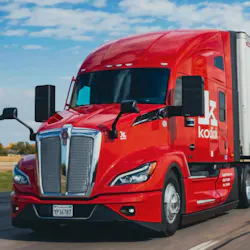
Asked by Evercore’s John Sager how he assesses Kodiak’s three end markets and decides where to focus his time and the company’s capital, Burnette went back to the data and operating-system foundations he and his team built in the late 2010s. Models that need to learn the basics of navigating different environments, he said, use the same core data set and then adjust to unstructured environments (as in Kodiak’s work with the military or with Atlas Energy Solutions hauling tens of thousands of tons of sand in the Permian basin) or to the structured settings of long-haul driving.
Burnette said his top priority in recent years was to get trucks in the hands of customers—Atlas in particular—which meant that his time was spent more on the industrial side of the business. With the Atlas relationship on pace to reach 100 vehicles by next summer and Kodiak having picked up “incredibly valuable learnings” about customer-owned fleets, that focus has recently been primarily directed at long-haul work, which has the largest total value of Kodiak’s three possible markets.
A key milestone is close on that front: Kodiak said October 6 that its measure of autonomy readiness now stands at 96% (up three points from the end of August and 12 points since February) as its team has progressed through its testing and validation checklists. That puts the unsupervised and driverless Ikea launch well within reach.
And while the long-haul safety and development work won’t be done when Kodiak’s measure hits 100%, there’s a chance that Burnette and his team will again be spending more time on its other markets soon. That’s the nature of the business model they’ve put in place.
“Sometimes, you surge into a program. Sometimes, there’s a little bit of a lull that allows you to focus on some other things,” Burnette said. “They’re all kind of existing at the same time, but your focus shifts strategically [and] sequentially from one to the other as necessary in order to continue to push in all directions.”
Volvo launches Texas operations for Warp platform
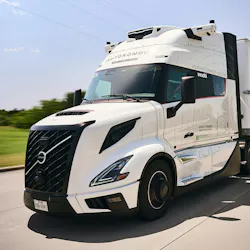
Other autonomous-driving efforts are also making progress in parts of the country that have laid the regulatory foundation for such efforts. Among them are Volvo Autonomous Solutions’ partnership with artificial-intelligence platform developer Waabi, which this week announced that it has started autonomous operations for open-source freight network Warp along the Dallas-Houston corridor Kodiak plans to start running soon.
Volvo Autonomous Solutions’ purpose-built trucks and Waabi’s software are taking aim at both the truckload and less-than-truckload markets served by Warp, which counts Walmart and DoorDash as clients. The companies’ work on the Dallas-Houston route, which will still feature an observer in the driver’s seat, will give them information to help them quickly expand.
“We are bringing autonomous freight into customer operations in one of logistics’ most demanding segments,” Nils Jaeger, president of Volvo Autonomous Solutions, said in a statement. “This shows how quickly our ecosystem can adapt to new customers and more complex operations. What we learn on the Dallas–Houston corridor will help us strengthen our partnership and continuously improve the ecosystem as we scale.”
About the Author
 Geert De Lombaerde
Geert De Lombaerde
Senior Editor
A native of Belgium, Geert De Lombaerde has more than two decades of experience in business journalism. Since 2021, he has written about markets and economic trends for Endeavor Business Media publications FleetOwner, Healthcare Innovation, IndustryWeek, Oil & Gas Journal, and T&D World.
With a degree in journalism from the University of Missouri, he began his reporting career at the Business Courier in Cincinnati. He later was managing editor and editor of the Nashville Business Journal. Most recently, he oversaw the online and print products of the Nashville Post and reported primarily on Middle Tennessee’s finance sector and many of its publicly traded companies.