AI 101: What the technology can offer fleet operations
Key takeaways
- Generative, predictive, and AI-assisted optimization are key functions that can improve routing, maintenance, customer service, and more within fleet management.
- Industry leaders like PCS Software advocate for experimentation and early adoption of AI, encouraging organizations to learn from mistakes and integrate AI into daily operations.
- Fleets that delay implementing AI risk falling behind competitors who leverage the technology for smarter, more resilient operations.

The phrase “artificial intelligence,” or what most of us call AI, was first coined in 1956 at a conference at Dartmouth College. It took nearly 70 years for the technology to become widely available to the public. We can thank OpenAI for this.
OpenAI launched ChatGPT in November 2022. Less than two months later, in January 2023, ChatGPT had an estimated 100 million monthly users, making it the fastest-growing user base of its time, surpassing TikTok and Instagram, according to analysts.
Today, ChatGPT and its competitors—such as Anthropic’s Claude and Google’s Gemini—are embedded into our workspaces, our personal lives, and our entertainment. It’s something we can’t escape.
Artificial intelligence is all over the trucking industry. Transportation technology conferences are filled with breakout sessions and keynotes that heavily use phrases such as “AI integration,” “AI innovation,” and other AI “I” words.
Yet, here we are nearly four years after OpenAI made AI accessible to everyone, opening a Pandora’s box of artificial intelligence, and it still feels like a new technology that we’ve barely grasped.
Overcrowding recently prevented me from attending an AI breakout session at a transportation technology conference. The topic of this particular session was “How commercial fleets are using AI to thrive in the modern world.” The description stated: “Learn practical strategies using AI to increase operational visibility, support drivers, control costs, and build a more resilient, agile operation.” Apparently, everyone and their mother needed to hear this information.
The session’s popularity was telling: While the technology has been accessible to us for years, we still have questions. We still need to know how to better integrate it into our operations or, perhaps, how to start integrating it.
It has been nearly 12 months since I attended the most educational, informative session about this powerful technology at PCS Software’s annual customer conference in Houston. PCS Software is a transportation management platform, and while it’s smaller than the Samsaras and Geotabs of the industry, its approach to AI made more sense to me than its larger competitors.
Instead of spending his whole keynote touting how his company uses AI, Mark Hill, PCS Software CEO, spent time educating his customers on the “how” and “why” of AI. I walked away from that keynote more confident in my knowledge of AI and understanding how it can improve the transportation industry’s productivity.
Our industry is just weeks away from the fall trade show and conference season, where AI is sure to be a strong talking point. I’ve turned my notes from Hill’s keynote into an article below to help our readers better prepare for the show season ahead.

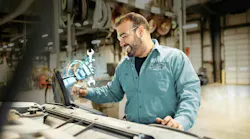 A truck maintenance technician using an advanced diagnostic device to analyze vehicle data in a garage bay, illustrating the application of AI for predictive maintenance and operational efficiency.
AI is the next big technology revolution
What even is artificial intelligence? Simply put, AI is a more advanced type of machine learning. IBM states that AI “enables computers and machines to simulate human learning, comprehension, problem solving, decision making, creativity, and autonomy.” Those who use this technology have access to more than just the whole internet. If the technology is connected to their workflows and data systems within their business, they can recall any information, distill any insight, and even use the tech to make decisions for the business.
In many cases, AI can help distill tedious work into a comprehensive report within minutes.
“It was like magic,” Hill said of the launch of ChatGPT during the PCS Software user conference last year. “It was like all of a sudden, a third arm grew out of each one of our bodies, and we never even knew it was happening.”
Hill believes AI's accessibility is the next big revelation in technology, much like the internet revolutionized how we live and work. The smartphone caused a revolution in how we do…everything.
With this in mind, Hill knew PCS Software would be better to embrace the technology rather than fight it. He encouraged his team to begin using ChatGPT on an experimental basis, giving them freedom to trial the tech and even to make a few mistakes.
“It's OK if you mess up, you break it, it doesn't work, you waste money, you waste time—I don't care, as long as you're trying within your department or as a person. Go. Give it a whirl. Let's see what happens,’” Hill said to his team back in 2024.
The team then began using AI for documentation, communication, analysis, and more. The more PCS employees used AI, the better the results became.
“We really worked hard to make sure that we were embedding that in our organization,” Hill said. “Now, I didn't know at the time where this was going to take us as a product. I didn't know how we were going to embed it in the product, and I didn't know how it was going to help us build products.”
AI for fleet business use
AI has several different general functions. One is generative.
Generative AI can “generate” lists, images, graphics, and more. Hill used the example of planning a trip to San Antonio to celebrate his wife’s 50th birthday. Oh, and she hates history, but loves art. Entering all of this information into an AI chatbot can generate a list of things to do in San Antonio.
But beyond helping plan a vacation, generative AI can create reports, spreadsheets, and more using any data it has access to, including fleet data.
AI can also predict outcomes. Predictive AI is used in the trucking industry today, with the rise of predictive maintenance. Predictive AI looks at historical data to predict what could happen in the future.
AI can also help with optimization, or as Hill explained, “best-case options.” We see AI optimization regularly in routing to get a delivery to its destination in the safest, most efficient way. Hill said optimization is the best AI function because it uses historical data and, with math and other tools, weighs different options and their possible outcomes to present the best-case option.
Next is conversational AI. This is present today in voice agents often used with customer service and support. The AI has become so advanced that it can understand tone and inflection. In essence, it’s building its emotional intelligence the more it speaks and hears humans.
Reading through these functions, where could you see AI helping your business?
Are you ready for artificial intelligence?
The consensus among trucking technology experts is that if fleets don’t start using artificial intelligence in their operations, they will fall behind. “Where” to use AI and “how” to use AI are decisions fleet leaders must make for themselves, but it is a decision that should be made quickly. Competing against fleets whose employees all have three arms while your employees have the standard two puts your business at a disadvantage.
Though I was turned away from the AI breakout session at a recent conference, this doesn’t mean fleets aren’t already experimenting. It could very well mean that these fleet leaders are looking to amplify their use of AI even more. There are fleets out there fleets that have had AI experts flown into their headquarters to help them build out entire AI programs in their operations. Don’t assume your company will be fine by sitting this one out. AI is here to stay.
Take a note from Mark Hill. If you’re not already encouraging your employees to use AI, start today. Allow them the freedom to make mistakes, but challenge them to turn those mistakes into lessons. Most of us already use AI in our personal lives. It’s worth a trial in our professional lives. The quicker we implement AI in our operations and the less we fight progress, the better prepared we’ll be moving forward.
About the Author
 Jade Brasher
Jade Brasher
Executive Editor Jade Brasher has covered vocational trucking and fleets since 2018. A graduate of The University of Alabama with a degree in journalism, Jade enjoys telling stories about the people behind the wheel and the intricate processes of the ever-evolving trucking industry.