MicroVision aims to usher in the next generation of lidar technology
Key takeaways
- MicroVision aims to make lidar technology more affordable and versatile for multiple industries beyond autonomous vehicles.
- The company's four-pillar strategy emphasizes product diversification, cost-effective design, software innovation, and disciplined financial management.
- Enhanced ADAS and driverless trucking could benefit from improved lidar systems, increasing safety, operational efficiency, and enabling 24-hour autonomous operations.
- An on-road demo highlighted the ability of lidar to detect objects, measure speeds, and build detailed maps, with future versions expected to be even more advanced.
- MicroVision plans to offer scalable lidar units like Halo, Iris, Movis, and FMCW, adaptable to various vehicle types and industry needs, driving the next wave of lidar adoption.

LAS VEGAS—Lidar, or light detection and ranging, has been around since the 1960s. For decades, the technology was used in aerospace; the National Aeronautics and Space Administration (NASA) used the technology to map the surface area of the moon. Then other companies began using the technology for topographic mapping to understand ocean water properties, glaciers, and forest canopies, according to FlyGuys.
Once GPS technology came along, lidar became even more powerful. Today, many industries use lidar technology, including trucking with autonomous operations.
Autonomous vehicle technology relies on lidar to “understand” its surroundings. Lidar uses rapid radar pulses to gather information about obstacles and their position to essentially create a 3D map of what’s around the vehicle.
The technology has been proven. Autonomous trucking developers are completing successful driverless trucking routes each day. However, it comes at a cost. MicroVision is on a mission to bring lidar to more commercial industries at a more affordable cost.
MicroVision’s lidar 2.0

If lidar’s 1.0 era was all about proof of concept, MicroVision’s lidar 2.0 era is all about value realization. For MicroVision, this realization will take place via a four-pillar strategy. The first pillar is a broad product portfolio.
“We have to diversify our portfolio—in other words, smooth out these revenue peaks and valleys,” Greg Scharenbroch, MicroVision’s VP of global engineering, said during a presentation ahead of the ACT Expo here. “We're going to do that by developing core technology that's modular and scalable and reusable with very little incremental effort across automotive and commercial vehicle, industrial, and security and defense.”
The second pillar of MicroVision’s strategy is to design for cost. This is a strategy that’s popular in automotive, an industry from which many of MicroVision’s employees come. The idea behind designing to cost places not only innovation as a focus of development but also considers the cost of the product’s hardware, its software, how it will be manufactured, its serviceability, and its reliability. In essence, it places a focus on the end user burden, from upfront purchase to running the equipment in their operations.
Next is MicroVision’s pillar of having a software advantage.
“Hardware costs are going to continue to drive down, so what's going to be left is our ability to offer capability and performance in software and offering that to customers,” Scharenbroch said. “That software will be a differentiator.”
MicroVision’s software advantage will also include an open software framework, allowing MicroVision customers and partners to apply their code directly to MicroVision’s lidar systems. This helps reduce their own development times.
The fourth pillar of MicroVision’s strategy is to accomplish all of this while practicing financial discipline. Scharenbroch touted his team’s ability to stick to budgets. The team has a “fixed budget, a spend envelope, and a run rate—and we don’t go beyond that,” he said.
So, how will MicroVision help bring lidar value to trucking?
Where the trucking industry can find value in lidar technology

While lidar is used in autonomous trucking, it can also be used to strengthen advanced driver assistance systems (ADAS). ADAS systems are already widely used in trucking. These systems help warn drivers when they are straying from their lane, when a potential forward collision is possible, and more. Some systems feature automatic emergency braking and pedestrian detection.
Not only do these systems increase operator and other motorists’ safety, but they can also help save serious cash on accident avoidance alone. A study from Bosch shows that ADAS can help reduce accident-related costs by nearly four cents per mile.
These systems also contribute to lower accident costs (by about 15%) and lower insurance costs (by about 20%), according to surveys conducted by the Insurance Institute of Highway Safety and the Federal Motor Carrier Safety Administration, Scharenbroch said.
ADAS systems might also increase operational efficiency in trucks. Scharenbroch said a study conducted by Bendix on its Wingman ADAS system revealed that drivers performed fewer harsh decelerations, exhibited smooth and consistent speed profiles, and saw less wear and tear on the trucks.
Adding higher-performing and more cost-efficient lidar systems to ADAS could improve these numbers even more.
Then there’s the benefit of driverless operations, which lidar enables. While driverless operations are currently undergoing testing, they are driving real routes across the U.S. Once this technology gets approved for full-scale operation, trucking companies will no longer have to abide by truckers’ hours of service rules: These trucks could run 24-hour operations if needed.
MicroVision’s lidar tech demo
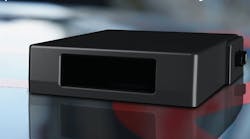

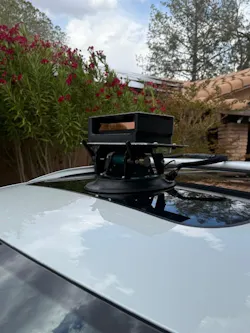
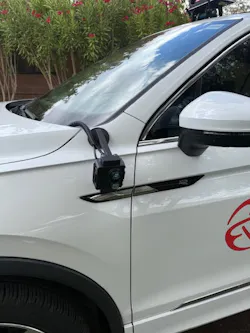
The final portion of MicroVision’s presentation included an on-road demo of its system. Each member of the media in attendance had their chance to climb into the back seat of MicroVision’s on-site Volkswagen Tiguan, equipped with the company's lidar sensors all along the front, back, sides, and top of the vehicle.
With demonstration monitors visible to the occupants, we were able to see everything the lidar picked up on, from the road surface (distinguishing between asphalt and the dirt on the side of the road) to curbs, to trees, to other vehicles, and even trash bins. The lidar could detect which vehicle was a passenger vehicle, a large truck, a pedestrian, and more.
The distance and accuracy at which the lidar detected objects were impressive. In addition, the lidar could detect the speed each vehicle was traveling and predict its speed over the next few seconds.
As the lidar recorded the route of the vehicle, it was saving data and information to build a map.
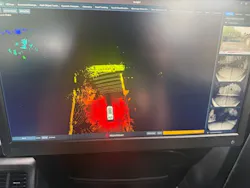
This monitor shows what the MicroVision lidar system detects around it. Here, the vehicle is parked, road surface is indicated in red, and the yellow shows dirt surface, a wall, and trash bins.
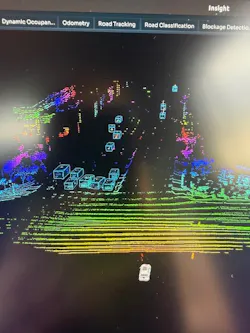
This view from the monitor displays a busy intersection. Here, the road surface is yellow and black, and the boxes indicate vehicles.
Worth noting, the demo of the MicroVision lidar system was essentially run on a prototype system. MicroVision anticipates the production version to be even better.
MicroVision’s goal is to sell its lidar units—Halo, Iris, Movis, and FMCW—with scalability in mind, allowing OEMs to integrate these into all types of vehicles, applications, and industries using only the necessary equipment to improve cost efficiency.
While MicroVision has been around for roughly three decades, the company’s recent advancements in its lidar system have come rapidly. MicroVision is ushering in lidar 2.0.
About the Author

Jade Brasher
Executive Editor Jade Brasher has covered vocational trucking and fleets since 2018. A graduate of The University of Alabama with a degree in journalism, Jade enjoys telling stories about the people behind the wheel and the intricate processes of the ever-evolving trucking industry.