The economics and barriers of electric terminal tractors
Key takeaways
- Most fleets that adopted electric terminal tractors report savings and operational benefits after four years, with some moving toward full fleet integration.
- High upfront costs and infrastructure limitations are the primary barriers to scaling electric fleet adoption, despite potential long-term savings.
- Fleets with electric units experience significant reductions in maintenance costs and downtime, but challenges like grid capacity and yard layout persist.
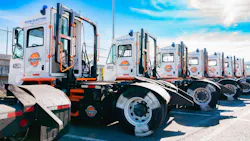
In the early 2020s, when electric vehicles (EVs) experienced their biggest hype days, some fleets climbed aboard the EV Express. EVs were a new technology at the time (one could argue they are still unproven), so these fleets took a risk. They developed charging infrastructure, invested twice the amount of a diesel-powered rig, and introduced their drivers to a zero-vibration, zero-noise, and zero-emission machine.
But the hype has passed. Diesel-powered trucks are king. And that fact would be even more true if U.S. diesel fuel prices weren’t affected by a strip of water in the Middle East. Yet, what happened with those fleets that boarded the EV Express?
The North American Council for Freight Efficiency (NACFE) recently published a report to answer this very question. The report includes insights and takeaways from interviews with seven fleets that use electric terminal tractors, as well as insights from industry partners, such as OEMs who sell EVs. These fleets adopted electric terminal trucks in 2022, and NACFE caught up with them to see how things are going four years later.
High-level findings
For the fleets NACFE interviewed, all but one of them have deemed them successful, and several are moving from a pilot phase to standardization, the report found. Economics is the main driving force for those that plan to roll out EVs through their entire fleet. But for those that are still unsure about a fleet-wide rollout, economics is also the main determining factor. NACFE’s report surveyed the fleets’ adoption drivers and confidence in EVs for those that continue to adopt them.
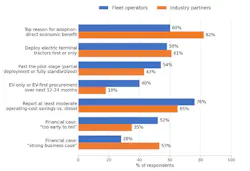
Economic factors are the reason that 60% of fleets adopt electric vehicles, but 52% think four years in operation is still “too early to tell” whether there is a strong financial case for full adoption. Further, only 28% of fleets that have adopted EVs see them as having a strong financial business case. This could largely be due to the high upfront costs of EVs compared to diesel operations. These costs include the sticker price that’s typically twice as high as diesel and the cost to develop charging infrastructure.
Yet most fleets with EVs in operation (76%) are seeing at least moderate savings with their EVs compared to diesel. One fleet, Lazer Logistics, “reports a roughly 50% reduction in maintenance and repair cost per operating hour on electric units compared to diesel,” the report states. Another fleet, Wegmans Food Markets, cites reduced maintenance, considering EVs have fewer moving parts and no aftertreatment systems to maintain.
The figure above clearly shows gaps between the sentiments of fleet operators compared to industry partners, however. This comes down to perspective. For example, where the graph shows fleets moving past the pilot stage into partial deployment or fully standardized, 54% of fleet operators agree, while only 43% of industry partners agree.
“This gap may reflect replacement-cycle timing rather than hesitancy: because terminal tractors typically remain in service for seven to 10 years, a fleet can commit to electric as it's standard for all new purchases and still operate a mixed fleet for years while older diesel units cycle out,” the report states.
A fleet-by-fleet breakdown
NACFE interviewed seven fleets that currently run or have run EV operations.
Wegmans Food Markets runs 18 electric yard trucks across three distribution centers. These EVs make up the company’s entire fleet of yard trucks. The company acquired its first electric truck in 2021—with the aid of state grants—after implementing internal sustainability goals.
Wegmans targets a battery life of seven to 10 years, is realizing maintenance and time savings, and has already shifted its charging strategy from 22kW chargers to a standard CCS-1 charger to increase charger-to-vehicle compatibility.
YMX Logistics is a yard management provider. The company operates terminal tractors on behalf of other businesses. YMX operates roughly 200 terminal tractors nationwide, and nearly 50 of those units are electric. The company’s electric units operate at 95% to 98% uptime compared to sub-90% uptime with its diesel-powered units.
“YMX is not without real operational friction,” NACFE writes in the report, as high-voltage components require OEM-trained technicians. On the other hand, diesel components are available anywhere.
Coke Canada Bottling operates eight terminal tractors across its 42 locations, with three electric units and a fourth planned in 2027. Coke Canada Bottling has operated one of those electric units since 2020. Coke Canada admits a modest return on investment for its electric units, which is nearly identical to its return on investment for diesel-powered trucks at “around 25%.”
Adding more EVs to its fleet is also heavily dependent on government incentives, one of which has already expired. Additionally, adding electric units to its Alberta site is unfeasible considering the province’s natural gas-powered grid reduces the carbon-emissions-reduction benefit of running electric vehicles.
 tailpipe emissions
 Sigma Powertrain EMAX heavy duty transmission
Lazer Logistics is another yard management provider—the largest in North America. It operates roughly 2,100 terminal tractors at more than 800 locations across 43 states and Canada. About 150 of those terminal tractors are electric, which comprises about 7% of Lazer Logistics’ fleet. Lazer Logistics reports “a roughly 50% reduction in maintenance and repair cost per operating hour on electric units compared to diesel of the same model year, rising to as much as 75% in a unit’s early years.”
The company also reports a 75% to 95% reduction in net costs per operating hour (calculating this as diesel fuel minus the cost of electricity). However, the exact reduction depends on the climate, diesel price, and duty cycle.
Bourassa Transport operates a single electric yard tractor unit in its less-than-truckload operations. Bourassa has less data on this unit’s operation compared to diesel as it has only been in the fleet since April 2026. However, Bourassa’s fleet manager Marilyn Bourassa cited the lack of terminal tractor-specific tires for electric units as a concern, as torque and weight appears to accelerate tire wear.
Pitt Ohio operates 35 terminal tractors across 25 terminals. Two of those 35 units are electric. The company has elected not to scale its electric fleet further (at least for now) due to the lack of infrastructure availability. “Only some of its terminals currently have enough electrical service to support terminal tractor charging alongside its other electric yard equipment,” the report states.
Pitt Ohio has found significant savings with its electric units, however, saving roughly $10,000 a year per unit in fuel savings alone. But that savings hasn’t yet helped Pitt Ohio reach price parity with diesel (it recently bought a gently used diesel unit for a third of the price of an electric one).
The final fleet NACFE interviewed requested anonymity. It operates roughly 400 terminal tractors, none of which are electric. The company also has no plans to adopt electric units. This company’s fleet vehicles experience above 50% idle time on some units, but the way leadership addressed this was simply “just stop the idle time, next subject,” NACFE reports.
Senior leadership concludes that implementing electric terminal tractors would require a broad company-wide initiative. Influencing this decision is likely a previous electric vehicle pilot the company performed with 10 electric Class 8 delivery trucks. The company had a negative experience, citing “poor performance and inadequate manufacturer support.”
Where adoption struggles
If it doesn’t make sense economically, company leadership isn’t likely to be on board. Electric units typically carry a sticker price that’s twice that of diesel units, sometimes higher. This has proven to be the biggest barrier to scaling adoption, according to NACFE data, regardless of the vehicle’s overall total cost of ownership or its return on investment. The graph below highlights this. The higher upfront cost is the single largest barrier in scaling adoption for 63% of fleets.
“That mismatch between a large, immediate capital ask and a savings case that accrues slowly is what pushes capital budgeting ahead of every other barrier fleets report, including infrastructure,” the report states. “Unlike a grid upgrade, which a fleet can sequence and phase over time, a fleet either has budget approved for a $300,000 unit in a given cycle or it does not.”
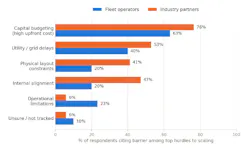
The second-largest barrier is utility/grid delays, with 40% of fleet respondents citing the issue. A fleet cannot effectively operate electric vehicles unless it has the on-site power to charge them. While terminal tractors require much less power than a Class 8 electric truck, even a “modest per-unit [electric] draw doesn’t eliminate the buildout problem at scale,” NACFE states.
NACFE found that only some of the terminals owned by the fleets surveyed have enough electrical service to power more electric units.
Additional barriers include layout constraints, where one fleet cited an electric yard tractor’s “wheelbase was too long for a tight yard application.” Other fleets might not have space in their yard to install chargers. Another barrier was “internal alignment,” or the absence of corporate approval. Operational limitations are another barrier, which could include cold-weather operations, duty-cycle needs, and more.
Regardless of the obstacles, these fleets continue to make electrification a reality in their terminal tractor fleets.
About the Author
 Jade Brasher
Jade Brasher
Executive Editor Jade Brasher has covered vocational trucking and fleets since 2018. A graduate of The University of Alabama with a degree in journalism, Jade enjoys telling stories about the people behind the wheel and the intricate processes of the ever-evolving trucking industry.