From ‘America First’ to ‘America: dead last’
Key takeaways
- Proposed rollback of U.S. emissions standards aims to reduce vehicle costs by approximately $1,000, potentially making new cars more affordable for consumers.
- Critics warn that relaxing standards could lead to increased fuel consumption, higher long-term costs, and stifle innovation in fuel efficiency and electric vehicle development.
- Major automakers, including Ford, Stellantis, and Toyota, support the rollback.
- The shift may benefit global automakers, especially Chinese EV manufacturers, by allowing U.S. automakers to prioritize cost cutting over innovation, risking America's competitiveness.

I’ve been blessed to travel. I’m also blessed (or cursed?) with an analytical mind that loves research. I’ve read about different foreign countries’ emissions standards, and I’ve visited countries where the Ford blue oval and the Chevrolet bowtie are present on a significant number of cars. While Ram trucks are less visible outside North America, I know that Peugeot, Fiat, and other Stellantis brands are favorites of consumers across the globe.
Whether we like it or not, Detroit’s famous Big Three cater to more than just Americans. They’re global auto manufacturers that compete in a global market. This means they must adhere to the emissions regulations of each country where they sell vehicles. That’s why when I hear of sweeping emissions changes proposed by legislators in Washington, D.C., I get a little nervous about how those proposals, if becoming law, will affect the American auto industry five to 10 years down the road.
Long-awaited relief or an attack on auto innovation?
Will rolling back these standards help consumers and fleet owners with lower costs?
One such proposal on the table—and a directive straight from President Trump and U.S. Department of Transportation leader Sean Duffy—is to reset the National Highway Traffic Safety Administration's (NHTSA) corporate average fuel economy (CAFE) standards. These standards have been in place since the 1970s. Yet current Biden-era CAFE standards have received criticism. A fact sheet from Trump’s NHTSA states that the current CAFE regulations created a “back-door EV mandate” by establishing “impossible” standards only achievable by electric vehicles.
NHTSA states that repealing these standards will bring down the cost of new vehicles. This is because, per a White House press release, OEMs increase the price of their gas-powered vehicles to make up for the losses from developing electric vehicles. In a nutshell, resetting CAFE standards will result in a savings of at least $1,000 for Americans purchasing their next new vehicle, the White House states.
The downside of resetting CAFE standards means that OEMs that sell vehicles in the U.S. are no longer mandated to continue innovation on fuel efficiency gains. This could lead to gas-guzzling SUVs and trucks driven by everyday Americans and fleets that could struggle to make ends meet when fuel prices rise. (Would this proposal have come had the administration predicted that fuel prices would break records this year?)
The International Council on Clean Transportation (ICCT) analyzed consumer costs if CAFE standards were reset. The council’s findings are shown in the chart below. Columns feature the cost component, lines indicate the increase in costs, dark columns represent NHTSA’s analysis, and light columns indicate ICCT’s findings “by fixing inappropriate, outdated, or incorrect assumptions.”
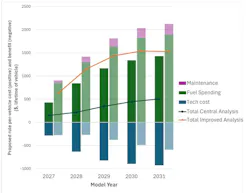
“As the chart illustrates, under NHTSA’s own analysis, consumer fuel spending outweighs the technology cost savings across MY 2027-2031,” ICCT states.
Rolling back these standards “in the middle of an oil crisis” would “cost consumers tens of billions more at the pump,” Leo Menninger, senior analyst at InfluenceMap, said in a press release. InfluenceMap is a UK-based nonprofit community interest company. The company has outlined more details of the proposal, titled SAFE III, on its website.
 Sigma Powertrain EMAX heavy duty transmission
 Diesel prices hit $5.97 as oil tops $100 amid Iran conflict
Will this proposal hinder automotive innovation?
Another perceived downside to SAFE III is the potential to stunt American OEMs’ innovation at a time when the automotive industry is becoming swallowed by competition from China on a global scale.
“It will also hurt the competitiveness of the American auto industry as Chinese electric vehicle manufacturers capture more of the global market with highly efficient and affordable EVs,” Menninger said.
Yet, if this were true, would several OEMs that are based in or operate in the U.S. back the proposal? InfluenceMap’s website highlights all the legacy automakers that have backed the proposal. The list includes Ford, Stellantis, Toyota, Mazda, Hyundai, Nissan, Volkswagen Group, and others. InfluenceMap also states that General Motors indicated support of the changes but “did not explicitly support the targets.”
Because these OEMs sell vehicles in more than just the American market, does this mean they’ll use the profits from American sales to fuel vehicle innovation overseas? Or does it mean they bow out of global markets altogether?
The latter is far from likely, especially considering only two of the automakers on this list, Ford and General Motors, are headquartered in the U.S. But it raises the question: What do these OEMs have to gain by advocating for such measures?
Vehicle development takes several years, and if OEMs wanted to develop new, less fuel-efficient vehicles they could sell for two-and-a-half times more than they cost to make, is there even a demand for them? With fuel prices as high as they are today, increased demand for gas guzzlers isn’t a safe bet—even with that estimated $1,000 savings on the sticker price.
But as we all know, fuel prices have a way of coming down. When that happens, will Americans decide they don’t mind losing a few miles per gallon?
What do automakers have to lose if these standards remain the same?
Honda seems to think there’s billions of dollars to lose. The OEM is one of the few that did not join in on support of the SAFE III proposal, citing investment concerns: “Targets set too low may fail to provide signals necessary to drive long-term investment in multibillion-dollar powertrain programs,” InfluenceMap reported.
Does this signal Honda is a bit more concerned about its long-term strategy? After all, while the U.S. consumer and fleet owner don’t have the option of choosing cheaper, more efficient Chinese-built vehicles, these OEMs have to compete with Chinese OEMs in the global market.
America first or dead last?
In the best-case scenario, rolling back these standards would have what impact on the automotive industry? Allow OEMs to make cheaper vehicles? Vehicles that are only $1,000 cheaper for the consumer? How long will OEMs pass that savings onto customers? If $1,000 is what stands between consumers and a new car, then yes, we might see a few more new vehicles on the highway. But with the added maintenance and fuel costs associated with less fuel-efficient vehicles, will that $1,000 savings be worth it in the end?
The downside to rolling back standards is that it allows U.S. automakers and those that sell in the market to become more lax in their innovation on a global scale. It opens the door for automakers in other countries to continue EV, hybrid, and alternative fuel innovation while leaving the U.S. far behind. American politicians are within their rights to preach “America first,” but they shouldn’t ignore the fact that American automakers compete on a global scale. American automakers need the resources—and yes, sometimes the push—to ensure they remain competitive globally.
“As EV adoption hits record highs worldwide, US automakers' efforts to stall policies enabling vehicle decarbonization are simply out of step with market realities," Menninger told FleetOwner. "They risk ceding further ground to faster-moving competitors, who are producing vehicles that avoid rising gas prices, and responding to growing consumer demand. Maintaining ambitious standards in the U.S. would address fuel costs, which are a key factor in consumer choice, and help US automakers produce such vehicles. By supporting the repeal of the policy, manufacturers are undercutting their ability to compete in the global EV race."
I don’t want to see the day when I visit a foreign country and see no blue ovals or bowties in sight.
About the Author
 Jade Brasher
Jade Brasher
Executive Editor Jade Brasher has covered vocational trucking and fleets since 2018. A graduate of The University of Alabama with a degree in journalism, Jade enjoys telling stories about the people behind the wheel and the intricate processes of the ever-evolving trucking industry.