January trailer orders hold steady as delayed cycle drives demand
Key takeaways
- January orders defy slump: Preliminary net orders held steady above 23,000 units, bucking the typical seasonal slowdown as a "delayed" buying cycle takes hold.
- Fleets' front-run costs: Carriers are accelerating equipment purchases to get ahead of potential tariff-driven price hikes and looming EPA 2027 regulations.
- Freight fundamentals improve: Rising spot rates and the strongest carrier profitability signals since 2022 are boosting fleet confidence to replace aging equipment.
- Production remains muted: Despite the order resilience, U.S. trailer build rates linger near 15-year lows, leaving OEMs with thin backlogs for the year ahead.

Preliminary U.S. trailer orders remained resilient in January, hovering above the 23,000-unit mark for the second consecutive month. While orders retreated slightly from December’s year-end surge, the data from two leading commercial vehicle market research firms suggests a delayed ordering cycle is underway, driven by fleet replacement needs and a scramble to get ahead of looming tariff-related cost increases.
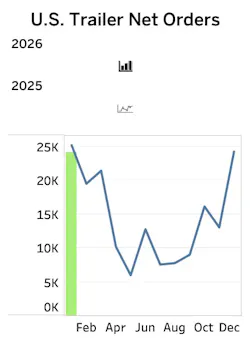
According to FTR Transportation Intelligence: January net orders were essentially flat month over month at 24,206 units. While this sustained the momentum seen in December, orders were down 4% year over year and remained below FTR’s 10-year January average of 26,340 units.
According to ACT Research: Preliminary January orders reached 23,000 units, a modest 8% decrease from December’s 25,100-unit level. However, this volume was more than 9% higher than the orders tracked in January 2025. When seasonally adjusted, ACT noted the monthly tally lowers to 19,700 units.
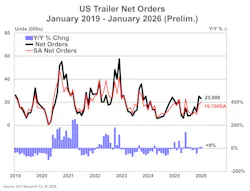
Traditional trailer-buying season shifts: Typically, January marks the start of a seasonal slowdown, during which manufacturers focus on clearing backlogs. However, analysts suggest the 2026 cycle is behaving differently.
What they’re saying: “Fleet decision-making hesitance into late 2025 seems to have delayed the cycle a bit, causing January orders to follow the traditional pattern but still surprising on the high side,” Jennifer McNealy, director of CV market research at ACT Research, stated. She attributed the sustained demand to a "firmer economic foundation," increasingly aged fleets, and a spike in freight rates.
Dan Moyer, FTR senior analyst, noted: “Positive indicators from the truck freight market and improved regulatory clarity are much-needed boosts to the U.S. trailer market, but manufacturers and fleet purchasers still must deal with cost inflation and trade uncertainty that continue to shape pricing and demand.”
Key drivers behind the January demand: Both firms identified several overlapping factors keeping the orderboards active:
- Tariff front-running: Fleets are likely advancing purchases to avoid potential cost pass-throughs from Section 232 metals tariffs and the ongoing antidumping investigation into van trailer imports.
- Improving carrier fundamentals: FTR’s Trucking Conditions Index reached its strongest level since February 2022 in December, signaling better profitability for for-hire carriers.
- Freight rate spikes: Severe weather in December and January sparked outsized spot rate increases, providing a much-needed boost to carrier sentiment.
- Regulatory clarity: Improved visibility into EPA 2027 NOx regulations has enabled better long-term capital equipment planning.
Production remains near 15-year lows: Despite steady new order intake, the manufacturing side remains subdued. FTR reported that while production increased in line with seasonal expectations, output remains at its lowest levels since late 2010.
Because net orders exceeded builds by a wide margin in January, backlogs increased sequentially. However, total backlogs remain substantially lower than they were at this time in 2025, leaving OEMs with "thin" cushions for the remainder of the year.
2026 trailer market outlook: Cautious optimism meets policy risk: While the start of 2026 has shown more life than the previous year, analysts warn that the recovery is still fragile. FTR noted that the total 2026 order season (September through January) is still down 16% compared to the same period last year.
“The Trump administration reportedly is considering a narrower approach to certain Section 232 steel and aluminum tariffs,” FTR’s Moyer noted. “That move could ease cost pass-through pressures at the margin, though no formal policy change has been announced.”
ACT’s McNealy raised questions regarding the sustainability of 20,000-plus unit months: “The questions now become how sustainable are 20,000-plus-unit order intake months, and how quickly will trailer OEMs build down the still-thin backlog, particularly given concerns about the level of activity in the key freight generating economic sectors that drive transportation demand, still weak, although improving, for-hire carrier profitability, and uncertainty about future government policies that remain as challenges to stronger trailer demand in the near term.”
About the Author
 Josh Fisher
Josh Fisher
Editor-in-Chief
Editor-in-Chief Josh Fisher has been with FleetOwner since 2017. He covers everything from modern fleet management to operational efficiency, artificial intelligence, autonomous trucking, alternative fuels and powertrains, regulations, and emerging transportation technology. Based in Maryland, he writes the Lane Shift Ahead column about the changing North American transportation landscape.