Fleets Explained: How commercial tire retreading works
Key takeaways
- Modern retreading technology improves casing inspection, tread application, and retread consistency.
- Multiple retreads can help fleets lower tire costs and cost per mile.
- Proper inflation and maintenance remain key to preventing casing failures.
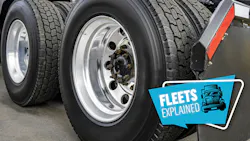
Technology has profoundly affected every facet of modern life. The improvements are too numerous to count, and every industry has benefited from technological advancements. Truck tire retreading is definitely one industry that has benefited from technology. Improvements in every step of the process have improved the safety and performance of today’s retreaded truck tires.
Let’s start with the radial truck tire itself. High-quality truck tires are designed, engineered, and manufactured for retreading. A truck tire without the tread is called the casing, and it accounts for most of the cost, materials, and energy required to build a truck tire. A quality casing can be retreaded multiple times at a fraction of the cost of a new tire. Each retread lowers the cost per mile to operate, which translates to higher profits for the fleet. By purchasing truck tires with quality casings, fleets lay the foundation for a tire and retread program that ultimately delivers the lowest possible cost per mile.
With quality casings in place, the next step is inspection. Decades ago, a technician would visually inspect the tire for conditions that could cause a casing failure. Retread plants had machines that could detect small punctures invisible to the naked eye, but the main concern is a casing separation that can lead to a roadside failure. In the “old” days, inspection was definitely hit-or-miss.
High-tech inspection and automated buffing eliminate guesswork
Modern retread plants use a non-destructive inspection machine called shearography to detect casing separations. These machines use a camera to take pictures around the tire's inner circumference. The shearography machine then creates a vacuum and takes the same pictures in the same locations for comparison. If the casing has any separations, the vacuum will cause movement, and by comparing the pictures, the machine can detect even the smallest separations in the tread. Previously unseen conditions become visible to the retreader, so they can analyze the casing much better before it enters the retread process.
Once the casing passes inspection, the old tread must be removed through a process called buffing. Again, decades ago this required the technician to select the correct template for the buffed surface so the tread would have the proper radius. Then the technician would manually adjust the buffer to remove the tread until the proper diameter was achieved. The process was somewhat automated but still heavily dependent on the human factor, which often varied.
Computer buffers changed everything and basically eliminated the human element. The buffed radius and diameter are entered into the machine for each different make and model of casing. Technicians don’t have to look up the radius, select the template, or measure the diameter. All they have to do is ensure the make, model, and size are entered correctly, and even that process is automated with barcodes, so the technician doesn't have to program the data manually. A simple barcode scan tells the buffer everything it needs to know to produce a perfectly buffed radius with an exact diameter.
This gives modern retreads unmatched uniformity. Unlike the old days, when a technician had to physically measure the diameter and then control how much tread was removed, computer buffers are automated and programmed to deliver the exact radius and diameter without human intervention. At one point not long ago, retreads had to be matched before installation in dual positions. Those days are long gone.

 fleets_explained_global_trucking
Once the casing is buffed, the next step is to apply the tread. At this point, there are two systems: mold cure and precure. In the mold cure process, technicians apply raw rubber to the casing as one continuous, thin strip in a process similar to new tire manufacturing. The process gradually builds it up in layers until it achieves the proper radius and diameter. Again, in the “old” days, this process depended on a technician, while modern mold cure retread plants have builders to automate the process.
In a precure retread, the tread rubber is already cured, so the tread is in place. Precure tread rubber comes in rolls, so technicians apply it to the casing as one long strip of cured tread. Not long ago, the roll would sit on the ground, and the technician would physically guide it onto the casing as it slowly rotated. It was a demanding process that required strength, dexterity, and skill to center the tread on the casing and keep it straight. Once the technician had the correct tread length in place, they would cut and connect the two ends. As a result, the tread pattern would rarely match at the splice.
To get the mold-cure or precure tread rubber to bond with the casing, a thin layer of uncured rubber called cushion gum is needed. In the old process, cushion gum came in rolls, and technicians applied cement to the casing before manually positioning it. It wasn’t as demanding as the precure tread rubber application, but it still required some skill and expertise from the technician.
Today’s cushion is extruded onto the casing in a perfectly thin and even layer. After buffing, there are usually areas where rocks or debris have reached the steel belts without penetrating the innerliner. This damage must be removed in what’s called a buzz-out or skive, where a technician removes the damaged rubber and then fills it with raw rubber from an extruder gun. Modern cushion gum extruders fill small skives while maintaining a perfectly even layer of uncured rubber so the mold-cure rubber or precure tread bonds with the casing. They improve efficiency and accuracy, create a more uniform surface, and eliminate the need for cement.
Precure retread plants use cushion gum extruders before positioning the casing on an automated builder. These machines measure the diameter so operators can lay out precured tread rubber on a long table with rollers. The tread is then cut to the exact length for the diameter, so the tread pattern matches at the splice. Using lasers, the tread is then guided onto the casing so it is perfectly centered. From the technician's perspective, it's much easier and requires far less effort and skill than the previous generation of precure retreading.
Once the tread is in place, the curing process must take place. For mold-cure retreads, the casing and raw rubber are placed in a mold that is essentially the same as a new tire. The mold segments close around the tire and imprint the tread design. Technically, the casing and raw rubber must be exact in diameter. Too much rubber and the casing will buckle under the pressure. Too little rubber and there won’t be enough to fill the molds, leaving areas where the tread isn't fully imprinted. Mold cure retreading is very similar to the new tire manufacturing process and requires a high degree of precision in buffing and building before the tread can be cured with heat and pressure to complete the process.
On the precure side, the tire is placed in a rubber envelope that is sealed at the beads. A vacuum is pulled through a special valve, creating pressure on the tread and pressing it onto the casing. Sometimes, another envelope is placed inside the tire and sealed at the beads to create internal pressure that will “sandwich” the tread between the two envelopes. The precure retread is then placed in an autoclave, or chamber, which preserves the vacuum on each tire while adding the heat and pressure needed to cure the tread rubber to the casing fully. After a few hours, the precure tread is fully bonded with the casing.
These aren’t your father’s retreads. What was once a labor-intensive process requiring a high degree of craftsmanship has evolved into modern manufacturing. From start to finish, automation and computerization produce a more uniform, reliable product. Casing issues are identified before they get to the buffer. Before building, every casing is buffed to an exact radius and precise diameter. The process of applying uncured tread rubber during the mold cure process is automated to the millimeter, while precure tread rubber application is measured and centered on the casing for a perfect splice match.
Lowering cost per mile: Debunking the roadside blowout myth
The environmental and economic advantages of retreading are well-documented. According to the Tire Retread and Information Bureau (TRIB), retreading saves enough energy to power over 1.1 million homes for a year, saves 343 million gallons of oil, and diverts 663 million pounds of landfill material, reducing tire waste by 473 million pounds. On the economic side, fleets with an effective retread program achieve the lowest cost per mile by preserving their casing assets, getting over 500,000 miles out of every new tire and subsequent retreads. The fact that new replacement tires and retreads are about the same, around 15 million each year, supports the lower operating costs.
Finally, for those who think tire debris on the side of the road is related to retreading, studies show the debris is split equally between new tires and retreads. Additionally, most roadside tire debris will show steel belts, which means the casing failed. If a retread fails, the belts will still be intact. Casing failure is almost always caused by underinflation or overloading. The resulting internal heat buildup will cause a new tire to fail, too.
Without retreads, everything would cost more. Trash and recycling costs would skyrocket because both industries rely heavily on retreaded tires. Everyone would feel the pain at the pump as reliance on oil for new tire production increased, and energy costs would also rise. Retreading is good business for fleets and supports environmental sustainability in multiple ways. With advances in technology, they are more reliable than ever, with a safety record equal to that of new tires when properly inflated and maintained.
About the Author
Kevin Rohlwing
Kevin Rohlwing is the SVP of training for the Tire Industry Association. He has more than 40 years of experience in the tire industry and has created programs to help train more than 180,000 technicians.