Football season congestion: What the World Cup taught cities about traffic
Key takeaways
- Geotab's data from the World Cup helps predict traffic patterns for the 2026 football season.
- Atlanta improved its traffic resilience by implementing pre-paid parking, street closures, and proactive communication with fleet companies.
- Cities can learn from Atlanta's strategies to reduce congestion, such as coordinated road closures and targeted communication with fleet operators.
Football season begins this month. Fans will soon flock to college towns and NFL cities. Trucks and commercial vehicles will share the roads with SUVs piled with fans wearing their teams’ colors. Deliveries on game days within the city will likely feel the brunt of the impact.
Looking at World Cup data from transportation technology provider Geotab will help fleet managers better understand how these games will affect traffic congestion.
While the FIFA World Cup is an event like none other, drawing soccer fans from all over the world during the summer months, Geotab found traffic patterns to be similar to event traffic, such as concerts and other sports events, at other times of the year. Therefore, the World Cup data can be used to predict traffic patterns for the 2026 football season—especially those few hours after the final whistle.
“The post-game aftermath … is where we saw that big spike” for most cities, Geotab’s VP of data and analytics, Mike Branch, told FleetOwner. “So if I’m a fleet and I’m planning my routing, my schedule … as much as I can [I want] to start avoiding those areas specifically in the time when the gates are exiting.”
With that in mind, let’s see what one city did in particular to help ease the burden on fleets and other motorists during World Cup matches.
How Geotab’s World Cup traffic data can provide insight to 2026 football season traffic
Before World Cup matches began, Geotab released a list of cities it believed would be the most impacted by traffic from the games. Using data from high-trafficked events in the same stadiums within the year leading up to the games, Geotab ranked each city from what it believed were the most prepared to the least prepared—or specifically, a prediction on “how well each host city’s network can handle the 2026 tournament?”
Geotab released another list after the World Cup games that showed the reality of each city’s traffic resiliency during high-trafficked events. While some of Geotab’s initial predictions were correct, other cities performed much better (and yes, much worse) than Geotab predicted.
One city that stuck out—in a positive way—was Atlanta, Georgia.
A city well-known for its traffic congestion, Atlanta ranked 12th in Geotab’s initial predictions. Actual game day data revealed scores high enough to elevate the city to sixth overall.
“The one that surprised me the most is probably Atlanta,” Branch said, “and it was the resilience score that was the core attribute.”
Geotab’s “resilience” score indicates how well the road network recovered after the end of the game when traffic surged. This score is what brought down Gillette Stadium in Foxboro, Massachusetts, from Geotab’s initial prediction at No. 1 to the reality of World Cup game day at No. 5. But this score is also what helped Atlanta push through to No. 6.
How did Atlanta do it? According to Branch, Atlanta took steps to prepare for the games.
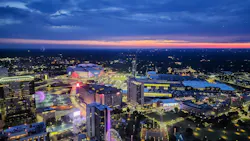
Mercedes-Benz Stadium, the site of the city’s World Cup games (and home to the NFL’s Atlanta Falcons), is located in the core of the downtown area. The area is typically heavily congested, and parking is often relegated to the streets or a few lots and garages.
To keep traffic to a minimum, Atlanta implemented prepaid parking near the stadium. Reserved parking ensured motorists weren’t driving around in circles looking for a place to park, which decreased the number of vehicles on the road.
The city also closed several streets throughout the area to help with stadium traffic and spread the word about these closures through multiple outlets, social media, and official government channels.
Finally—and likely the biggest aid to fleet drivers—city officials communicated traffic plans to commercial fleet companies.
“I know firsthand that they had a communication plan with some of the core fleets in the area, so that they notified them of the road closures ahead of time,” Branch said. “That was apparent in the data because we saw a decrease in fleet activity in and around that area for those time periods.”
 Aerial image of Toronto
 How truck drivers can improve safety around school buses and school zones
Could other cities learn from Atlanta and decrease traffic on event days?
Atlanta didn’t outperform every city on World Cup game days—it placed sixth overall. But based on historical data from events at Mercedes-Benz Stadium, the city outdid itself in traffic management.
The cities that performed the best were Houston, Texas, at NRG Stadium; Arlington, Texas, at AT&T Stadium; and Kansas City, Missouri, at Arrowhead Stadium. These stadiums all outperformed Atlanta in safety, which records risky driver behaviors in the area, and, of course, in congestion, since Mercedes-Benz is located in the heart of Atlanta’s downtown and the other stadiums are on the outskirts.
But Atlanta outperformed every city on the list in resiliency, with a score of 7.4 out of 10. This means Atlanta traffic took less time than any other city to return to normal, non-event traffic flow.
While Branch didn’t get a chance to chat with officials from every city on the list to determine whether they adopted the same or different strategies to combat traffic congestion, it appears that Atlanta’s efforts paid off.
Fleets can use this data to make delivery or route decisions on game days this fall when American football teams fill those same stadiums. They can also use this data to inform decisions for college football stadiums.
Additionally, fleets could reach out to city officials in advance of games to develop a dialogue about game-day road closures throughout the season and times when traffic is predicted to be most congested.
Any city officials reading this article could take a note from Atlanta: communicate with local fleets, implement road closures when necessary, and consider a more strategic parking plan for the surrounding area.
About the Author
 Jade Brasher
Jade Brasher
Executive Editor Jade Brasher has covered vocational trucking and fleets since 2018. A graduate of The University of Alabama with a degree in journalism, Jade enjoys telling stories about the people behind the wheel and the intricate processes of the ever-evolving trucking industry.