Rohlwing: The price of poor inflation
Key takeaways
- Proper tire inflation helps fleets reduce tire costs, prevent failures, and improve retread potential.
- Inflate-thru valve caps and accurate gauges support more effective tire pressure maintenance programs.
- OSHA requires specific inflation equipment practices to protect technicians during tire servicing.
It’s no secret that proper inflation is the key to controlling tire costs. Overinflation accelerates tread wear and increases the risk of an impact break, while prolonged underinflation typically leads to a belt separation and the need for emergency roadside service. Insufficient inflation pressure for the load is also a leading cause of casing fatigue that prohibits retreading. There’s no shortage of information on the negative effects of improper inflation pressure in truck tires.
Automatic tire inflation systems (ATIS) have significantly reduced inflation-related issues in trailer applications by providing a constant supply of air to the tires through the hollow axle. In my opinion, a fleet that doesn’t specify ATIS on new trailers is asking for higher tire costs. The lack of inflation pressure maintenance on trailer tires is well known, so failing to utilize this technology is difficult for me to comprehend.
Steer and drive tires are a completely different story. Tire pressure monitoring systems (TPMS) and hub-mounted inflators provide some measure of prevention. However, there will still be situations where a human being must physically check and adjust the inflation pressure. While it should be the drivers who check and adjust air pressure, that task often falls on maintenance technicians. As a result, many steer and drive tires are operating at improper inflation pressure.
For fleets to even hope for any type of inflation-pressure maintenance program, several key pieces of equipment must be in place. First, every tire must have an inflate-thru valve cap. This allows the driver or technician to check and adjust the inflation pressure without the additional steps of removing and then reinstalling the valve cap.
If the tire doesn’t have an inflate-thru valve cap, then it shouldn’t be a surprise if the pressure is checked with a boot-o-meter, hammer, or wooden club. Fleets that want any level of accountability must take the necessary steps to make it as easy as possible, and inflate-thru valve caps are critical components.
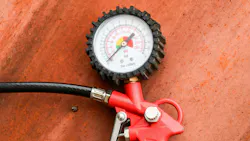
A quality air gauge is also essential. Fleets don’t have to spend a fortune on pressure gauges, but performance varies by manufacturer. When gauges fail, they can read either low or high. Fleets that expect inflation-pressure maintenance must have a verification system to ensure the gauges read correctly. The best tool to use is an inflation gauge check station with a dial gauge so the pressure on the handheld gauge can be verified quickly and easily; without that verification, the effort to check inflation pressure could be for naught.
When inflation pressure needs to be adjusted, the Occupational Safety and Health Administration (OSHA) regulates the equipment requirements. First, the inflation device must have a clip-on air chuck. A clip-on air chuck temporarily attaches to the valve stem via threads, so the technician does not have to hold it on the end of the valve stem. It doesn’t need to have a “clip,” but it cannot be threaded onto the valve. Dual foot inflators that lock into place without threading are considered clip-on air chucks by OSHA.
Next, the inflation device must have an in-line valve with a pressure gauge or a presettable pressure regulator. The in-line valve allows the driver/technician to control airflow, while the pressure gauge allows a pressure check without removing the clip-on air chuck. A regulated air line is acceptable because it can also prevent overinflation, which is the purpose of this OSHA requirement.
Finally, there must be a sufficient length of hose between the clip-on chuck, the in-line valve, or the regulator to keep the driver/technician outside the sidewall’s trajectory during inflation. OSHA doesn’t specify a specific length of hose that is “sufficient,” but most devices have a hose that is 6 or 10 feet. The key is to stand even with the tread and away from the sidewall during inflation.
Inflation pressure equipment is necessary based on a combination of best practices and OSHA regulations. Inflate-thru valve caps, high-quality inflation gauges, and a verification system are crucial components of inflation pressure maintenance. Likewise, the equipment specified by OSHA is critical for safety (and required by law) because it allows the driver or technician to adjust inflation pressure without standing in the sidewall’s trajectory and prevents accidental overinflation.
 Roadside tire service safety: How fleets can reduce technician accidents
 Truck tire prices face pressure from natural rubber, crude oil, and energy costs
About the Author
Kevin Rohlwing
Kevin Rohlwing is the SVP of training for the Tire Industry Association. He has more than 40 years of experience in the tire industry and has created programs to help train more than 180,000 technicians.