Roeth: Trucking moves closer to autonomy
Key takeaways
- Trucking technology is progressing through platooning, Level 2 systems, and early real-world demonstrations.
- A recent platooning project showed measurable fuel savings.
- Automation tech is advancing toward targeted use cases.
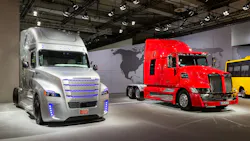
Technological change is a funny thing. Sometimes it feels like it is taking forever to move technology forward, and other times it seems like things happen quickly.
The reason I bring this up is that I recently had the opportunity to spend time with people who are working on various automation projects—and things are moving quickly in that area.
I learned about three projects, all under the same program managed by DriveOhio. I had the opportunity to review all three with a group of stakeholders at the Indiana Department of Transportation headquarters just outside Indianapolis.
The first was a platooning project that took place on rural Ohio highways. Two vehicles traveled a combined 24,422 miles, and when conditions permitted, they operated as a platoon and demonstrated the fact that platooning can save fuel. In this instance, the trucks were able to platoon 40% of the time, saving about $1,200 (319 gallons of diesel). That number would be higher today, given the current cost of diesel.
The second project was a test of SAE Level Two autonomy. In this case, Nussbaum operated a Freightliner truck with the Detroit Assurance 6.0 System. This system has a variety of automated features, including active lane assist, active brake assist, side guard assist, front guard alert, and more. These features are the building blocks of autonomy.
Finally, I talked to folks from Kodiak who completed a fully autonomous demonstration on Indiana and Ohio roads. While this was only a demonstration, they were able to collect data and map routes.
My biggest takeaway was that there are some really smart people working on autonomy in trucking. The whole topic is fascinating to me; I think I am seeing science fiction become nonfiction. The industry is starting to realize there are some niches where autonomous trucking will work. Like most technologies, both platooning and autonomous driving are not right for every use case. But where they make sense, they can provide efficiency improvements on a high level.
Additionally, it is important to note that these developments are not too far in the future. I am not saying they are going to happen tomorrow, but we are quickly making strides in the areas of platooning and autonomy. That means we all should start paying a little more attention to what’s going on in this space, not only so we can be well informed but also so fleets can take advantage of any automation opportunities that make sense given their operating parameters.
We are committed to continuing to cover autonomy in trucking. If you have not done so already, check some of the blogs we’ve written about autonomous trucking over the past five years.
 Fleet data helps cut diesel costs and improve efficiency amid high fuel prices
 Why trucking cycles through booms and busts, and what fleets should expect
About the Author
 Michael Roeth
Michael Roeth
Executive Director
Michael Roeth is the executive director of the North American Council for Freight Efficiency. He serves on the second National Academy of Sciences Committee on Technologies and Approaches for Reducing the Fuel Consumption of Medium and Heavy-Duty Vehicles and has held various positions with Navistar and Behr/Cummins.