Your fleet is running older than you think—and your safety score shows it
Key takeaways
- Most fleets run pre-2020 Class 8 trucks, linking aging equipment to rising safety and operational risk.
- Safety is widely impacted by older trucks, yet only 3.45% of fleets formally track safety as a KPI.
- CSA scores, insurance costs, and 2027 AEB rules are increasing pressure on fleets with outdated equipment.
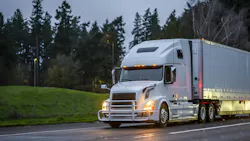
For most organizations with transportation fleets, the age of their truck equipment is a known risk, an open item on the balance sheet. But new data reveals a more troubling gap: Executives are watching their safety performance erode in real time, while tracking the wrong metrics to stop it.
Fleet safety risk rises as 58% operate pre-2020 Class 8 trucks
A recent 2026 Transportation Industry Benchmark Survey, compiled from responses that span across U.S. organizations with heavy-duty truck fleets, shows that 58.62% of organizations are operating Class 8 trucks model year 2019 or older. Nearly 41% of those fleets have between 1 and 25 aging units operating in their networks, while 31% manage 26 to 50 older trucks daily.
That is not a small problem buried at the edge of the organization’s operations. For many companies, pre-2020 equipment is built into the core of daily operations, dispatched every morning, accumulating miles, and adding incremental risk with each passing quarter.
When those same executives were asked whether aging equipment had affected their fleet’s safety performance, 75% said yes—41% said it had slightly affected safety, 34% said it had moderately affected safety, and 10% said it had significantly affected safety. Only one-quarter of respondents reported no impact at all.
Read that again: Three out of four leaders have already seen safety performance degrade from older equipment. The problem is not theoretical. It is happening in active transportation fleets today.
Fleets track fuel costs but overlook safety KPIs and risk exposure
Here is where the data turns genuinely alarming. When asked which key performance indicators they track most closely, executives ranked fuel economy (79%) and maintenance cost per mile (72%) as their top two metrics. These are reasonable, important numbers to manage. But scroll down the list of KPIs, and you’ll find the safety score is nearly invisible: only 3.45% of organizations formally track it.
The implication is hard to overstate. The majority of organizations have acknowledged that older trucks are degrading their safety outcomes, yet fewer than 1-in-28 are measuring safety performance as a tracked business metric. Fuel economy and maintenance costs are being managed with precision while safety drifts, unmeasured, in the background.
This is not a failure of intent. Organizational leaders clearly understand that safety matters. The gap is structural: the financial and operational KPIs that dominate fleet dashboards do not connect to the safety outcomes those same organizations are already experiencing on the road.
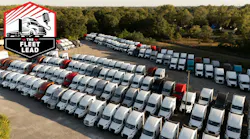 truck dealership
 International truck availability
CSA scores and maintenance violations are driving higher insurance costs
Every roadside inspection, every violation, every reportable crash feeds into a fleet's FMCSA CSA score, a public record that shippers, brokers, and insurers consult routinely. Older equipment tends to generate more vehicle maintenance violations: brake defects, lighting failures, and tire issues. Each one raises your Behavior Analysis and Safety Improvement Categories (BASIC) scores. Each BASIC score increase triggers greater inspection frequency, reduced shipper confidence, and, compounding the pain, higher insurance premiums.
The commercial trucking insurance market is under severe pressure. According to the American Transportation Research Institute (ATRI), insurance premiums hit a record $0.102 per mile in 2024, following a 12.5% spike in 2023. Nuclear verdicts—jury awards exceeding $10 million—have increased by 235% since 2012, and insurers are now scrutinizing safety records, telematics data, and compliance histories before issuing coverage. Fleets with poor CSA scores face higher premiums or loss of coverage altogether.
For an organization running a large percentage of pre-2020 trucks, this is not an abstract future risk. It is a present-day cost being absorbed, often without a clear line of sight connecting aging equipment to the insurance line item on the P&L.
2027 AEB mandate raises safety baseline for Class 7-8 truck fleets
The regulatory landscape is about to make this gap significantly more expensive to ignore. By model year 2027, all new Class 7 and Class 8 trucks must be equipped with automatic emergency braking (AEB) systems, per NHTSA and FMCSA rulemaking finalized in early 2025. The technology is projected to prevent roughly 19,000 crashes and save 155 lives annually.
Critically, regulators have confirmed that there will be no retrofit requirement, as older trucks already in service are not required to be upgraded. This may sound like relief, but it is actually a liability accelerant. As of the 2027 model year, every truck that rolls off the line will have AEB as a baseline standard. Private fleets continuing to run 2019 and older equipment will be operating units that lack the safety architecture that the industry and the courts will increasingly treat as unfavorable.
In litigation, that delta matters. Plaintiffs’ attorneys are already arguing that fleets without modern safety technology demonstrated negligence. Once AEB becomes a federal standard for new vehicles, the argument that an organization with a transportation fleet knowingly continued to operate older equipment without equivalent protection will become far more powerful before a jury.
Disconnect between ops and finance increases fleet safety and cost risk
The survey data surfaces one more insight worth close attention. When asked about strategic priorities for the next several years, 38% of transportation fleet executives said increasing organizational capability to scale more efficiently was a top goal. Yet only 10% identified improving cross-departmental alignment as a priority.
That asymmetry is significant. The safety-to-finance connection, the chain of causality that runs from equipment age to CSA scores to insurance premiums to total cost of ownership, requires COOs and CFOs to work from the same data. When safety is managed operationally but not financially tracked, the cost of poor safety performance accumulates invisibly until it surfaces as an unexpected insurance renewal, a regulatory intervention, or worse, a catastrophic incident.
Organizations that want to scale fleet capability efficiently cannot do that while carrying structural blind spots in their safety data. The two priorities are not in tension; they are the same problem.
Closing fleet safety data gaps to reduce risk and improve compliance outcomes
The data is clear. Older equipment is degrading safety performance. Safety performance is not being formally measured. Insurance markets are tightening. And a regulatory standard is arriving in 2027 that will redefine the baseline for what a safe, modern truck looks like.
Executives do not lack urgency; they lack visibility. The first step is straightforward: Add safety score as a tracked KPI alongside fuel economy and maintenance cost per mile. Until organizations with transportation fleets include this data in a single dashboard, the connection between aging assets and safety outcomes will remain a known risk that no one is formally managing.
The organizations that begin quantifying the safety cost of older equipment, and connecting it directly to insurance costs, CSA exposure, and life cycle planning, will be the ones best positioned to navigate what is shaping up to be one of the most consequential periods of regulatory and financial pressure the private fleet industry has faced in a decade.
About the Author
 Wesley Hall
Wesley Hall
Wesley Hall, CTP, is the senior director of asset performance and off lease at Fleet Advantage, an innovator in specialty financing, fleet data analytics, asset performance services, and life cycle cost management.