Clark: Agentic AI has powerful potential, but human judgment is still essential
Key takeaways
- Agentic AI can streamline fleet maintenance workflows by automating documentation and diagnostics support.
- Human oversight remains critical because AI lacks full understanding of fleet operations and business context.
- Fleets adopting agentic AI need guardrails, training, and governance to manage decision-making risks.
In a recent post, I discussed the need to upskill diesel technicians to keep pace with rapidly emerging technologies. One of the biggest forces driving that change is artificial intelligence (AI), often viewed as a silver bullet capable of streamlining processes, cutting costs, and improving accuracy and efficiency.
Now, with the rise of agentic AI, that perception is intensifying. Business leaders may feel increasing pressure to adopt these systems broadly, trusting them to handle complex workflows with minimal oversight. However, relying too heavily on this technology would be a mistake.
To understand why, it’s important to distinguish between generative AI (the technology we are familiar with) and its more autonomous counterpart.
Agentic AI vs. generative AI in fleet operations
According to Red Hat, an open hybrid cloud technology leader, “Generative AI creates context like text, images, or code in response to prompts.”
Agentic AI takes things further.
Red Hat continues, “Agentic AI acts as an autonomous system that plans, makes decisions, and executes multistep workflows using external tools to achieve a specific goal without continuous human intervention.”
At a recent NationaLease meeting, Armando J. Perez Carreno, principal software engineer at PerezCarreno & Coindreau, clarified the distinction between standard workflow automation and agentic AI.
Many fleets today already use workflow automation tools enhanced by AI. These systems streamline processes, improve visibility, reduce errors, and enhance efficiency; however, they don’t make major decisions. That responsibility remains firmly in human hands.
For example, in warehouse operations, automation and AI already play essential roles. Machines handle repetitive, high-volume tasks with precision, while human workers verify order accuracy, resolve discrepancies, and ensure customer satisfaction. This balance works because it combines speed and consistency with human judgment.
How agentic AI can improve fleet maintenance workflows
As Perez Carreno explains, agentic AI has the “same shape as a workflow but with judgment in the middle.” That added layer of reasoning introduces new capabilities and new risks.
Consider the following real-world fleet scenario:
- A technician records voice notes about a vehicle issue.
- Agentic AI converts those notes into a clean work order narrative.
- It flags potential warranty opportunities.
- It cross-references the unit’s history.
- It then suggests a likely root cause.
This represents a leap forward in efficiency and insight. It saves time, reduces administrative burden, and surfaces patterns that might otherwise be missed.
But this is exactly where caution is required.
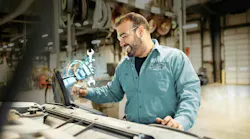 A truck maintenance technician using an advanced diagnostic device to analyze vehicle data in a garage bay, illustrating the application of AI for predictive maintenance and operational efficiency.
Why fleet managers must oversee AI-driven decisions
Despite its advancements, agentic AI has a critical limitation: It doesn’t truly understand your business. It doesn’t inherently know your customers, your inventory constraints, your operational nuances, or your strategic priorities. Unless that knowledge is carefully and continuously input and interpreted by humans, the system operates on an incomplete context—and this can lead to flawed recommendations.
An AI system might suggest a course of action that appears logical based on available data but is the exact opposite of what the situation requires. That’s why, as Perez Carreno emphasizes, agentic AI needs guardrails, especially when decisions carry high stakes. He made it clear that “high-stakes calls always go to a human.”
Managing risks of AI dependence in trucking operations
The growing sophistication of agentic AI can create a false sense of confidence. When systems appear capable of reasoning and acting independently, it’s tempting to trust them with broader responsibilities.
But organizations must resist the urge to fully delegate decision-making to what is fundamentally a tool—albeit a very smart tool—but still not a human being. We’ve seen some major, bizarre actions when AI outputs are assumed to be inherently correct. One has only to think of Waymo vehicles driving themselves into ditches or going in endless circles to know that every technology, even the smartest, has its limitations.
Over-reliance on technology introduces risks, including poor decision-making due to incomplete context, loss of critical thinking within teams, and, most seriously, increased vulnerability when systems fail or misrepresent data.
Building effective AI guardrails for fleet management
The goal isn’t to avoid agentic AI; it’s to use it wisely.
Organizations that succeed will be those that:
- Treat AI as a decision-support tool, not a decision-maker
- Maintain human oversight on all critical outcomes
- Continuously train employees to work alongside AI
- Invest in data quality and governance
- Build clear guardrails and accountability structures
Agentic AI represents a significant evolution in how work gets done. Its ability to reason, analyze, and act autonomously offers undeniable advantages across industries, from fleet maintenance to warehouse operations.
But no matter how advanced the technology becomes, it cannot replace the experience, intuition, and contextual understanding that humans bring to the table.
About the Author
Jane Clark
Senior VP of Operations
Jane Clark is the senior vice president of operations for NationaLease. Prior to joining NationaLease, Jane served as the area vice president for Randstad, one of the nation’s largest recruitment agencies, and before that, she served in management posts with QPS Companies, Pro Staff, and Manpower, Inc.