AI knows when to turn left; it still doesn’t know when to trade in a truck
Key takeaways
- AI adoption is strong in routing and maintenance, but lifecycle decisions remain a major opportunity.
- Fleet leaders can use AI analytics to improve the timing of truck acquisition and replacement.
- Total value of ownership (TVO) strategies help fleets make better long-term asset decisions.
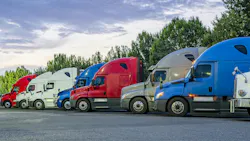
Artificial intelligence (AI) has made inroads in heavy-duty truck fleet management, and the data backs this up. Route optimization has reached 71% AI adoption among organizations with heavy-duty transportation fleets, while maintenance scheduling is not far behind at 64.5%.
These are not small achievements. When an algorithm can dynamically reroute a driver around a traffic bottleneck or flag a component for service before it fails on the highway, organizations see real, measurable value: fewer delays, lower fuel spend, and reduced roadside breakdowns.
These operational wins have justifiably built confidence in AI as a dynamic tool. But that confidence has obscured a structural gap in how AI is deployed across the full asset life cycle and how its use is managed.
Fleet life cycle decisions remain an AI adoption gap
Strip away the operational middle of the asset life cycle, and what remains are two decisions that carry far greater long-term financial consequences for organizations: When to acquire a truck and when to replace it.
According to a recent survey, 64.5% of organizations report they are not using AI for the lease-end process. The effective AI adoption rate for acquisition planning and end-of-life cycling sits at or near zero for most organizations. Decisions that should be informed by utilization history, maintenance cost trajectories, residual value curves, replacement economics, and total value of ownership (TVO) analysis are instead still being made with spreadsheets, gut instinct, and historical precedent—or unproven data analytics—even though analytics programs now exist to save organizations millions at lease end.
This is not a minor oversight. The cost of getting daily routing wrong is measured in hours. The cost of getting procurement and life cycle decisions wrong compounds over the years.
The challenge for many organizations is that they are still evaluating fleet performance through a traditional total cost of ownership (TCO) lens rather than a broader TVO strategy. TCO focuses primarily on expense containment: acquisition costs, maintenance spend, and fuel usage. TVO takes a more strategic approach by evaluating how procurement timing, vehicle specification, operational efficiency, replacement strategy, residual value performance, and life cycle optimization collectively contribute to long-term enterprise value.
How poor truck life cycle management increases fleet costs
Every year a truck operates past its optimal life cycle threshold, three things happen in parallel: maintenance and repair costs rise drastically, resale value erodes, and fuel efficiency declines. None of these trends reverses on its own; in fact, they accelerate.
Finance leaders and CFOs often underestimate this compounding dynamic because the costs are distributed across time and across departments. Maintenance costs appear in operations budgets. Fuel inefficiency gets absorbed into variable cost lines. Depressed resale value surfaces only at trade-in. No single report shows the full picture, which means organizations often fail to recognize how these disconnected variables collectively erode TVO over time.
Optimal life cycle management requires integrating data that currently resides across different systems and departments. Telematics data, maintenance records, fuel consumption logs, and residual value benchmarks each tell part of the story. Without the analytical infrastructure to bring them together, organizations are left making multi-million-dollar capital decisions with partial information.
AI insights here are important, but understand that AI alone cannot close this gap responsibly. Life cycle decisions involve financial commitments, contractual obligations, and strategic considerations that require experienced human judgment. The most effective approach pairs intelligent analytics with expert oversight from fleet and finance professionals who understand both the numbers, the assets, and the broader organizational context.
 Dispatch automation in trucking highlights limits of rules-based systems versus AI reasoning
AI life cycle analytics help fleets find the truck replacement point
The pressure to evaluate powertrain alternatives is rapidly sharpening the situation around life cycle analytics. In the recent survey mentioned, AI-driven fuel analysis jumped from near zero to 61.3% year-over-year adoption, driven by organizations racing to model diesel, CNG, and battery-electric scenarios. The question of which powertrain to acquire, and when, has become one of the most consequential capital decisions in today’s industry.
But fuel analysis is only as reliable as the TCO and TVO modeling beneath it. An organization evaluating a shift to battery-electric vehicles without integrated life cycle analytics is performing an incomplete calculation. Infrastructure costs, charging downtime, route compatibility, uncertainty in residual value for emerging technology, and replacement timing all factor into the true economic picture.
What integrated life cycle analytics makes possible: the tipping point
Asset life cycle management AI adoption grew from 9.5% to 38.7% in a single year. The interest is clearly there, but the deployment has not caught up. What’s more, only 6.9% of operators currently use predictive modeling for component failures, illustrating just how wide the gap between awareness and action remains.
When life cycle analytics are fully integrated, operations and finance leaders can determine the assets’ functional vs. economic obsolescence—what Fleet Advantage calls the TIPPINGPOINT—and how many years the truck can be operated vs. how many years it should be operated.
None of this replaces the experienced operations manager or CFO at the table. The data creates clarity; the human creates accountability. What analytics does is remove the information asymmetry that forces smart people into expensive guesses. AI optimizes the miles. But the decision about how many miles a truck should ever run, and what should replace it when the economics shift, remains a human responsibility, one that deserves the best possible analytical foundation.
The organizations that close this gap first will not just experience significant cost savings. They will acquire with far greater precision, and that advantage grows just as steadily as the costs of getting it wrong.
About the Author
 Mac Hudson
Mac Hudson
Mac Hudson is the senior off-lease manager at Fleet Advantage, an innovator in specialty financing, fleet data analytics, asset performance services, and life cycle cost management