
In 2025, safety culture in the trucking industry experienced several twists and turns. Cargo thieves tried new strategies, nuclear verdicts cost fleets in more ways than one, the truck parking shortage continued, and new ELP enforcement made waves throughout the industry.
But the news wasn’t all bad; fleets went all in on safety and developed robust safety cultures. New technology helped keep truck drivers, cargo, and pedestrians safe. Read through the top safety articles of 2025 to learn more.

10. Sharing the road with teen drivers: Prevent accidents during summer's 100 Deadliest Days
Between 2019 and 2023, accidents involving teen drivers claimed the lives of more than 13,000 individuals. Of those accidents, 30% took place during the same period: the days between Memorial Day and Labor Day, according to AAA. This timeframe is known as the 100 Deadliest Days.
“During the summer, it’s like someone just opened the floodgates,” Erin Gilchrist, VP of fleet evangelism at fleet management platform IntelliShift, told FleetOwner. “There are more inexperienced drivers, more unpredictable behavior, and more distractions on the road.” Read more…

9. An evolving safety program has proven the strength of this fleet’s safety culture
With the rise of nuclear verdicts and insurance premiums that increase each year, a fleet must ensure driver safety. But that’s easier said than done.
The safest fleets not only adhere to safety practices but also tout a safety culture. Safety cultures must be built.
TransWest, a fleet based in Washington, began its business with safety at the forefront. Twelve years later, the fleet has turned its 10-step safety program into an evolving safety culture that changes with its workforce. Read more…

8. Driving fleet safety forward: Implementing telematics, cameras, and driver training
The details of adopting telematics, camera systems, and driver training programs are important and require diligence in finding the right technology partners, but that’s the second step: The first is the decision to invest in and commit to a fleet safety upgrade.
That’s among the takeaways from a recent NAFA Media Connection conference call featuring a pair of fleet representatives who’ve just implemented new safety technologies. Read more…

7. How nuclear verdicts are driving up fleet insurance costs and reshaping risk strategies
Over the past decade, trucking companies have faced a growing concern: nuclear verdicts, or judgments exceeding $10 million in civil suits related to crashes. Insurance premiums and legal costs rise as a result, and these issues are spreading like a mushroom cloud at a time when fleets need to keep costs down as economic factors such as inflation and tariffs threaten to increase equipment and parts prices.
Commercial auto liabilities have experienced an annual growth of 10.1% since 2016, according to David McKnight, a principal at consulting firm The Brattle Group. He said this is the most significant increase in insurance segments tracked in his company’s Tort Costs in America study. Read more…

6. How to handle the 'chaos' after a truck crash
Truck drivers, fleet managers, and safety professionals alike work hard daily to prevent trucking accidents from happening on the road. But while prevention is ideal, understanding what to do after a crash is important.
Here at the Truckload Carriers Association’s 2025 Safety & Security Meeting, responding to trucking accidents is a hot topic, with drivers, insurance experts, and safety experts weighing in. Read more…
 Holiday-season cargo theft surges as thieves expand tactics and target high-demand freight
 FMCSA’s Safe Driver Apprenticeship Program struggles to collect data on under-21 CDL drivers
5. Cargo theft’s new normal: How we got here and how to protect your fleet
Cargo theft patterns are changing. Ever since the pandemic, the practice has accelerated and spread to areas that previously saw little criminal activity. Understanding the cargo theft evolution can be a fleet's first step in combating crime.
According to Verisk CargoNet, there were 1,781 reported cargo theft events in 2020. In 2024, the number of reported events increased to 3,625, a 21% rise from 2023. Read more…

4. New HOS pilot programs could give truck drivers more flexibility
For 50 years, we’ve familiarized ourselves with this phrase time and again. In our industry, however, you might be uttering: “Just when you thought you understood hours of service” as it pertains to a driver’s daily schedule and the nuances that always seem to exist for our industry’s much-maligned regulations.
If you stopped reading this column here, you might assume that this was about personal conveyance, electronic logging devices, or the emergency exemptions that often get issued when our nation needs our trucks to roll. However, this column deals with the recent news regarding the Pro-Trucker package that the Trump Administration issued as an executive order to improve the lives of America’s truck drivers. Read more…

3. Understanding the complexities of the truck parking shortage in the U.S.
Truck parking is one of the top issues for both fleets and drivers, according to the American Transportation Research Institute (ATRI). Limited safe truck parking has been an ongoing problem because of limited infrastructure, hours-of-service (HOS) changes, and more.
There is one parking space for every 11 drivers on the road, noted Doug Marcello, trucking and commercial transportation attorney with the law firm Saxton & Stump. “[When] you couple that with the hours-of-service requirement, that drivers can only drive 11 hours, be on duty 14 hours, it increases not just a demand but a timing for that demand, resulting in a number of them having to park on exit ramps, sides of roadways, etc.” Read more…

2. 100,000 eggs stolen: Breaking news or an old cargo theft trend?
Police are still investigating how cargo thieves stole approximately 100,000 eggs from a semi-trailer in Pennsylvania earlier this month, according to CBS News. With egg prices reaching historic highs this year, the heist is garnering a lot of public attention. But is this part of a new cargo theft trend or old news?
According to Scott Cornell, transportation lead and crime and theft specialist at Travelers, food and beverages are the most targeted commodities by cargo thieves. Because these products are constantly in demand, thefts of perishable items are not investigated for long periods of time. Read more…
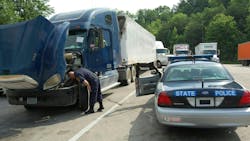
1. How to prepare for roadside English enforcement
English language proficiency requirements will come in full force later this month: On June 25, CVSA’s Out-of-Service Criteria will formally include ELP.
While many fleets already require ELP for new drivers, all motor carriers will soon face significant pressure to do so. If drivers do not know English well enough to pass roadside inspections, their loads could face major setbacks.
But what will an ELP inspection look like, and how can fleets prepare? Read more…
Along with these articles, FleetOwner publishes several popular annual features that garner attention throughout the trucking and transportation industries. These include our annual looks at the largest commercial transportation systems in the U.S., the FleetOwner 500: For-Hire and FleetOwner 500: Private Fleets.
Our annual profiles of women in the industry, Women in Transportation 2025, were published this summer. Each year, FleetOwner recognizes the transportation operations of private fleets with the FleetOwner Private Fleet of the Year award. This fall, we expanded and rebranded our annual New Models into the 2025 FleetOwner vehicle guide, our largest-ever look at the next generation of heavy-duty, medium-duty, light-duty, and alternative-powered trucks and vans.
We put a bow on the year with the 2025 Trucking By the Numbers feature, an info-graphical look at the facts and figures that make up the trucking and transportation industries.
To view what's ahead for FleetOwner in the new year, please check out our 2026 Media Kit.
About the Author
 Jenna Hume
Jenna Hume
Digital Editor
Digital Content Specialist Jenna Hume joined FleetOwner in November 2023 and previously worked as a writer in the gaming industry. She has a Bachelor of Fine Arts degree in creative writing from Truman State University and a master of Fine Arts degree in writing from Lindenwood University. She is currently based in Missouri.