Verisk CargoNet reports higher cargo theft losses despite fewer incidents
Key takeaways
- CargoNet recorded 547 supply chain crime incidents in Q3, down 33% year over year.
- Fictitious pickups accounted for 25% of Q3 incidents, up from 18% a year earlier.
- Estimated cargo theft losses reached $718.9 million through September, up 39% year over year.

Verisk CargoNet recently released its third-quarter cargo theft analysis, reporting fewer supply chain crime incidents but higher estimated losses across the U.S. and Canada. CargoNet recorded 547 cargo theft and supply chain crime incidents from July through September 2026—a 33% decrease from the same period in 2025 and a 19% decline from the second quarter.
Despite the drop in reported incidents, estimated losses reached $230.1 million in the third quarter, up 12% from $205.1 million a year earlier. Through September, estimated losses totaled $718.9 million, a 39% increase year over year. Reported incidents fell 25%, from 2,755 to 2,072, while the average value of stolen commodities with documented values increased approximately 72%, from $261,115 to $448,456.
Fictitious pickups remained a significant concern. CargoNet recorded 138 incidents in the third quarter, compared with 147 in the same period a year earlier. However, these incidents accounted for approximately 25% of reported activity, up from 18% in the third quarter of 2025. Fictitious pickups generally involve deception to obtain a shipment.
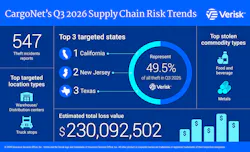


Food and beverage remained the leading commodity category, with 94 incidents, down from 178 a year earlier. Metals ranked second with 63 incidents, compared with 68 in the third quarter of 2025. Copper accounted for 34 metal thefts.
California, Illinois, New Jersey, and Texas accounted for 57% of reported third-quarter incidents. California recorded 182 incidents, followed by New Jersey with 46, Illinois with 40, and Texas with 43.
Verisk CargoNet also identified increasingly complex fraud schemes involving compromised business email accounts, internet-based phone systems, and transportation industry applications. Criminals use these methods to impersonate legitimate companies, obtain shipment information, or redirect freight already moving through the supply chain.
"We saw mixed results in the third quarter with a decline in reported incidents and fictitious pickups remaining close to last year’s level, but the estimated financial impact grew significantly,” Keith Lewis, VP of operations at CargoNet, said. "Understanding cargo theft requires looking beyond incident counts and focusing on broader trends, like what is being stolen and where theft is concentrated."
What this means for the trucking industry
Fewer reported thefts do not necessarily mean lower financial risk for fleets. The increase in average theft values and the continued prevalence of fictitious pickups point to the importance of verifying carrier and pickup identities before releasing freight. Shipment visibility and clear communication among shippers, carriers, and other supply chain partners can also help reduce opportunities for criminals to intercept or redirect high-value loads.
The fourth quarter warrants additional attention. CargoNet has historically observed increased theft activity during the holiday season and into the new year, when facility closures and reduced staffing may create opportunities for criminals.