Is your fleet ready for new engines, oils, or alternative fuels?
Key takeaways
- New EPA27 engines are launched, promising improved fuel efficiency but with uncertain warranty and maintenance implications due to pending regulations.
- Industry interest in alternative fuels like CNG and biofuels exists, driven by fuel cost volatility and potential for cost parity with diesel vehicles.
- Fleet owners are increasingly focusing on total cost of ownership (TCO), considering the impact of new engine costs, oil change intervals, and fuel prices on long-term operations.
- The narrative around alternative fuels is shifting from regulatory compliance to economic benefits, especially as fuel prices fluctuate and model year 2027 trucks approach.
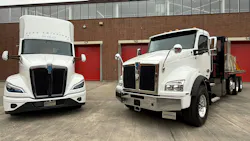
FleetOwner was recently invited to share what fleets are facing to an audience of professionals within the aftermarket segment of the industry. The presentation was part of a five-day event known as Heavy-Duty Leadership 2.0. Northwood University’s “University of the Aftermarket” held the event in Metro Detroit. Audience members consisted of those who work in the heavy-duty and commercial vehicle aftermarket space.
This is the second part of a two-part series on FleetOwner’s presentation at the HD Leadership 2.0 summit. Read part one on the economy and technician training.
FleetOwner’s job during the event was to give an overview of what’s been on fleet leaders’ radars in the past 12 months. FleetOwner analyzed its own data, as well as the data of our affiliate publication Fleet Maintenance, to help guide our discussion. Ultimately, we broke the discussion into four parts: the economy, technician training, new engines, and alternative fuels. The first part of this series covered the economy and technician training. This part will cover new engines and alternative fuels.
While the presentation spurred conversations across the room, we’re not authorized to share what was discussed. But perhaps you have some comments of your own?
New engines and new oils have been a hot topic among fleet leaders from July 2025 to July 2026
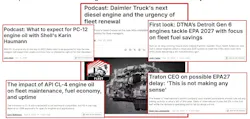
New engines that meet the EPA27 requirements have been a hot topic in the last six months, and with new engines come new oils. The heart of a fleet vehicle is its engine, so it only makes sense that articles about these new engines would be among our most-read articles of the year.
But these new engines don’t have a final regulatory ruling on them yet, making the waters even murkier for those who want and need a new truck, as well as for those who are making them.
In 2024, FleetOwner published multiple articles about the 2027 Prebuy that other industry players and we believed would begin in 2025. Because of the anticipated higher price of 2027 engines due to EPA27 standards, we assumed fleet leaders would accelerate truck orders and fill their fleets with model year 2025 and 2026 equipment.
Yet after Trump’s election in 2024, the industry knew EPA changes were coming. However, it wasn’t clear what exactly was changing, what was pausing, and what was staying the same. Even today, while we have clarity that the emissions standards on 2027 equipment will remain, we don’t have a final rule, though signs point to a shorter warranty.
Uncertain conditions kept truck orders dismal in 2025. And even OEMs, according to this article about International Truck’s parent company Traton, were getting frustrated with the lack of certainty. However, without additional guidance from the EPA, OEMs continued marching along with their model year engine innovations.
Most OEMs have launched their EPA27 engines by now, though we’re still waiting on Paccar’s announcement. As you could imagine, readers are curious how these engines will affect their operations. And maintenance personnel are interested in how the new engine oils will differ from previous iterations. As a result, these are our top-read stories.
FleetOwner and Fleet Maintenance staff think the clarity on the emissions portion of the EPA27 rule—which, again, we still don’t completely have—has also led to the increase in truck orders. We saw an increase in truck orders since late last year, and it’s only picked up since.
Another factor that could be linked to increased truck orders is the age of current fleet vehicles. Everyone knows the trucking economy has been bleak for years. Instead of dropping hundreds of thousands on new trucks, fleets have opted to drop tens of thousands on maintaining their current fleet.
Articles on preventive maintenance have also gained traction this year, and from what we’ve gathered at conferences and trade shows, fleets are becoming more and more interested in implementing predictive maintenance technologies into their fleet.
New engine and new oil headline predictions
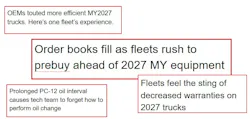
OEMs and other industry players do predict truck orders to continue filling out. Our staff is anxious to see July order numbers to confirm this, but we believe this could be the beginning of the “prebuy” that FleetOwner, Fleet Maintenance, and other industry publications spent a lot of effort writing about in 2024.
We also expect to hear feedback from fleet owners about these new engines and how they’re performing. We’re told that the EPA27 engines will increase fuel efficiency, but we also understand that anything new typically needs a year or so to iron out its wrinkles fully.
However, depending on the amount of 2025 and 2026 trucks ordered, 2027 model year trucks might be slow to sell and may take a while before they log many fleet miles.
In that same vein, if the final EPA27 rule passes, that warranty timeframe will be cut significantly. We expect this to cause an uproar within the industry when those vehicles begin needing service. Model year 2027 trucks are expected to be more expensive with more robust aftertreatment systems that may or may not come with extra maintenance requirements or adjustments, and we anticipate the owners of these trucks won’t be happy when the warranty runs out, and they’re expected to foot the bill.
While the bottom left headline is more of a joke, oil developers and manufacturers are hyping up this new oil’s ability to prolong oil change intervals. One podcast guest we had from Shell Rotella said intervals could easily reach 100,000 miles, and Valvoline has already done this with the Cummins X15 engine. That’s significant. While a technician isn’t likely to forget how to change oil, if intervals increase this much, fleet owners might see that reflected in the bottom line.
 truck acquisition and demand- podcast thumbnail concept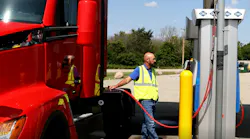
The alternative fuel conversation is changing rapidly. Here’s where the conversation is headed…
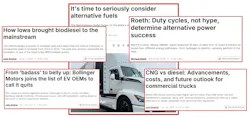
Alternative fuels can be a polarizing topic. Many folks in our industry don’t like the messaging in favor of alt fuels and EVs, or they don’t like being told what they can and can’t operate in their own fleet. These are 100% valid reasons to be Team Diesel.
Before 2025, EVs and alt fuels were hot topics. In 2025, those producing alt fuels and electric vehicles and folks at conferences and trade shows didn’t even want to broach the subject of alt fuels and EVs. It seemed that the pendulum had swung in the other direction. And in fact, that was the phrase often used when talking about emissions regulations and diesel power.
This lack of EV interest led to the closure of Bollinger Motors (this article was among our top-read stories in the alt-fuel category for 2025) as well as light-duty automakers reshuffling their EV plans, such as with the Ford Lightning and the Chevrolet BrightDrop van.
But there was another, unlikely article that made the 2025 Top 10 most-read articles. Technically, this article was published 13 months ago; therefore, it didn’t quite make the 12-month cutoff, but it deserves some attention because it shows that there still might be interest in alternative fuels.
The Iowa biodiesel article (top right) shows that while EVs were pushed out of the spotlight in 2025, the desire for alternative fuels did not vanish completely; this could be for reasons like fuel security, cleaner emissions, or affordability. This article was the eighth most read on the FleetOwner website in 2025, which surely signals there’s still an appetite for alt fuels.
Aside from the popular articles, we’re seeing the conversation about alt fuels and EVs shift in a different direction. When discussing alt fuels and EVs, economics now comes first, ahead of sustainability and environmental chatter.
This premise is behind our most-read article on alt fuels and EVs. The story in the middle was written this past April after fuel prices skyrocketed due to the Iran conflict. This story details that the last time fuel prices rose like this was during the Recession. At the time, the heavy-duty industry had no alternative powertrains. Everyone was a slave to the fuel lords.
Today, that isn’t the case. Just about every truck OEM has an electric option. Most engines run on B20 biofuels without modifications, and CNG is a viable option, with many fleets running the fuel in their operations today, which leads to the article written about CNG vs. diesel (bottom right).
This article wasn’t among our most read, but it’s important because it suggests that the increased price of EPA27-compliant trucks could bring alternative fuels, like CNG, closer to price parity with diesel trucks. And that’s significant. Electric vehicles and alternative powertrains aren’t experiments or pie-in-the-sky innovations that the industry should continue avoiding.
While these vehicles often come with a higher sticker price, the gap between the upfront costs of alt-fueled vehicles and diesel trucks is expected to narrow or even close. Then after that initial purchase, diesel vehicles with their aftertreatment system complications, the need for diesel exhaust fluid, and the variable cost of fuel keep their cost of operation high compared to a vehicle like CNG with a domestic fuel source that’s more stable and, because it burns cleaner, helps keep maintenance costs down.
Finally, with regulations having swung back in the other direction, the narrative around alt fuels and EVs has shifted from “It’s what our government is making us do” to “Hey, this could potentially save you a lot of money.” But be warned: Alternative fuels and electric vehicles will only save money if your fleet is a good candidate for them.
Diesel will be the king of long-haul trucking for a long time to come. But regional-haul and drayage applications will likely see a lot of benefits of switching to an alternative powertrain, as Mike Roeth, president of the North American Council for Freight Efficiency, wrote in the article displayed on the top right: “Duty cycles, not hype, determine alternative power success.”
FleetOwner headline predictions about alternative fuels and electric vehicles
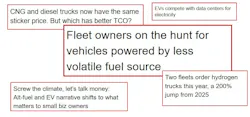
We believe fuel prices will continue their typical volatility. Yet, without an uptick in freight volume and with carriers feeling the pressure to purchase trucks before 2027, it’s likely fuel costs could become quite the nuisance. We predict fleet leaders, while they might not purchase any alternative-fueled vehicles, will begin to ask their dealers more questions about them.
Once model year 2027 trucks are available, we predict a higher sticker price. While it might not reach the price of a CNG-powered vehicle, that will eventually come. The question then will be which vehicle has the better TCO.
For fleets operating or considering electric vehicles, one thing to keep in mind is that they need electricity to operate, and we’ve seen some nationwide grid issues. Power outages, blackouts, skyrocketing costs, and soon, competition with data centers could cause problems when charging electric vehicles. This is something worth keeping an eye on.
The narrative behind alt fuels is very quickly moving to TCO. Dealers and OEMs can’t use those federal incentives to entice buyers anymore, so the natural progression is to show actual data and comparison between diesel-powered vehicles and alt fuels.
Finally, hydrogen hasn’t fully gone away, but its growth in the industry seems to be happening at a microscopic rate. FleetOwner will continue bringing hydrogen news as it happens.
If any of these headlines are printed, how is your business ready to handle it? Have you experienced some of this already? Do you agree with any of these predictions? Let us know with a comment below or by reaching out through our social channels on LinkedIn, Facebook, or Twitter.
About the Author
 Jade Brasher
Jade Brasher
Executive Editor Jade Brasher has covered vocational trucking and fleets since 2018. A graduate of The University of Alabama with a degree in journalism, Jade enjoys telling stories about the people behind the wheel and the intricate processes of the ever-evolving trucking industry.