Heavy-duty vehicle industry insights: Economy and technician training trends
Key takeaways
- Tariffs and regulatory enforcement significantly impacted freight demand, truck orders, and capacity, leading to industry uncertainty and capacity exits in 2025.
- Despite rising rates and truck orders since late 2025, overall industry outlook remains cautious because of economic headwinds like high interest rates and slow construction activity.
- Technician shortages persist, with emphasis on retention, training, apprenticeships, and attracting new talent from Gen Z and Gen Alpha demographics.

The heavy-duty vehicle industry is bigger than most realize. While our readership consists mostly of those in the fleet segment of the industry, the industry’s reach includes manufacturers—OEMs, suppliers, suppliers of suppliers—dealers, technicians, aftermarket product companies, and so much more.
FleetOwner was recently invited to share what fleets are facing to an audience of professionals within these other segments of the industry. FleetOwner’s presentation took place on day one of the five-day event, known as Heavy-Duty Leadership 2.0. The event was held by Northwood University’s “University of the Aftermarket.” Audience members consisted of those who work in the heavy-duty and commercial vehicle aftermarket space.
FleetOwner was asked to provide an overview of what’s been on fleet leaders’ radars in the past 12 months by analyzing some of our top-read articles. We also gathered the same data from our affiliate publication Fleet Maintenance to help guide our discussion. Ultimately, we broke the discussion into four parts: the economy, technician training, new engines, and alternative fuels. This piece will cover the economy and technician training. New engines and alternative fuels are featured in the second part of this series.
The presentation spurred conversations across the room. While we’re not authorized to share what was said during these conversations, perhaps you have some comments of your own?
How the economy impacted trucking from July 2025 to July 2026
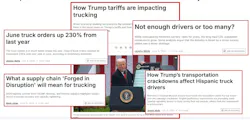
Tariffs were the top economic headline in 2025. Our most-read article of the year was a landing page with live updates of tariff news throughout the year. But CDL regulations and enforcement also played big roles in terms of what’s impacting drivers and capacity. The FleetOwner economics coverage could be segmented into three categories: rates, freight demand, and driver capacity.
Rates and truck orders
The good news is a lot of the chaos, uncertainty, and other negative buzzwords that led to top stories from the past year have largely calmed down. Further, if you base the strength of the trucking industry solely on rates and truck orders, things have looked pretty good since December 2025 through June 2026. Last month, in June, truck orders were “about 68% above the 10-year June average.”
Secondly, spot rates have been rising since December 2025 (although they are beginning to flatten). Industry experts and players believe that this rise is due to exiting capacity, meaning fleet companies have shuttered and left the business, and some owner-operators have bowed out. This has pushed spot rates higher simply through supply and demand. A rise in spot rates is usually followed by a rise in contract rates.
However, rates and truck orders do not tell the whole story.
Tariffs spelled bad news for trucking
Many analysts and experts predicted 2025 to be a prosperous year for the industry. Unfortunately, tariffs paralyzed corporate decision-makers. For many, 2025 was a year of stalls, reorganizations, and overall timidity, which kept freight movement low. This is because companies weren’t making anything, no one was building anything, and just about everyone was in a “wait and see” mode.
Even after tariff chaos quieted down, things still looked bleak. As Jeremy Wolfe, FleetOwner’s regulations and government expert, stated: “Once the smoke cleared, tariffs were not good news for domestic manufacturing in 2025, which kept freight demand disappointingly flat for longer than expected.”
These tariff announcements spelled bad news for trucking in more ways than just freight demand. Volvo Trucks and Mack Trucks laid off factory workers and blamed it on the tariffs, Knight-Swift blamed tariffs for a slow economic recovery, and tariffs were blamed for the lack of truck orders and declining port activity—a key market for freight movement.
This chaos in the freight market spurred the massive capacity exits we saw throughout 2025. This is what industry players like Uber Freight and U.S. Bank believed caused rates to improve in December.
The CDL crackdown
What also contributed to shrinking capacity was the crackdown on non-domiciled CDLs, or CDLs issued to, usually, a noncitizen by a state where that person does not have a permanent residence. Legally, a non-domiciled CDL is set to expire after a certain timeframe, and these CDL holders would have their license revoked. This was more heavily enforced in the second half of last year and continues today, taking thousands of truck drivers off the roads.
The lack of English proficiency has also been added to the list of what will take a CDL holder out of service, contributing to the exiting capacity.
Those stories, as well as those about the driver shortage, whether it exists or not, were also top stories last year.
The bottom line: Trucking is still a bit chaotic
As Kevin Jones, industry veteran and FleetOwner and Fleet Maintenance content director, pointed out, the bottom line is that “uncertainty remains the issue. No one can plan; that means everyone is in wait-and-see mode, up and down the supply chain. And that is multiplied for those whose business serves the supply chain—such as trucking.”
Jones highlights this sentiment in his recent headline, “What a supply chain forged in disruption will mean for trucking.” This is based on a major annual report that explains how the market is still extremely volatile with regulations, fuel prices, and global trade.
 truck at loading dock with line chart
 USDOT and DHS expand CDL school fraud investigations across training providers
Economic headlines we predict will be printed in the future
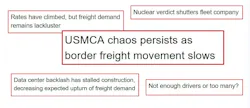
The editorial teams at FleetOwner and Fleet Maintenance don’t predict much of an increase in freight demand. What gets freight moving is a healthy economy full of spenders. Right now, money is tight in households across America, leading to less spending.
Interest rates and the lack of housing prevent many folks from buying, which is another source of freight demand. And the construction industry is also in a slowdown. At the beginning of the year, industry analysts predicted that data centers would be a top source of construction freight, but the public’s opinion on them is keeping that from accelerating as well.
Adding to the lack of freight from domestic sources, Jeremy Wolfe also predicts that there will be chaos coming soon from the results—or lack of—from the United States-Mexico-Canade Agreement (USMCA). We’ve made this the biggest headline in our predictions because we believe the USMCA storyline will have a significant impact on the trucking industry.
Finally, we predict conversations around the driver shortage will continue, so we added the same headline as before: “Not enough drivers or too many.”
Here’s what fleet leaders and maintenance professionals have on their minds about technician training
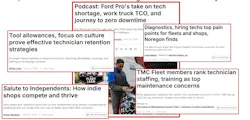
Judging from the top stories listed above, the top concern among shops is clear. Like the driver shortage in trucking, there’s a technician shortage too. And that’s what most of the top stories were about: the technician shortage or retaining the ones you have.
All of the top stories came from Fleet Maintenance, so FleetOwner sought John Hitch, Fleet Maintenance editor in chief, to get better insight. He noted the tech shortage has been something the industry has warned about for more than 20 years.
He did say, however, that recognizing a problem and fixing it are two different things. Fleet Maintenance regularly talks to the leaders of key organizations, such as the ASE Education Foundation, and hears from fleet managers and shops about what the big issue is, which is actually quite similar to what’s happening with truck drivers. The problem in the shop might not be so much finding good technicians but in actually keeping them.
Kevin Jones, our content director, said it’s likely a problem that hasn’t been resolved simply because leaders aren’t speaking directly with the technicians. There have also been multiple technician surveys conducted by WrenchWay, TechForce Foundation, and others, in which technicians state they want a clear career path and better training.
For tech retention, this is a multipronged approach that includes good pay and benefits. But the most successful shops give technicians agency over their work. They listen to their technicians' concerns and address their problems immediately. The best retention rates are found in shops that show they care.
Technician headlines we predict will be printed in the future
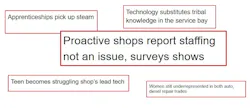
Fleet Maintenance's John Hitch predicted the headlines above. He believes that it’s the shops that listen to their technicians, address their problems, and show they care that will see the most success in tech retention.
He also believes that apprenticeships will continue to grow. Currently, it does not appear shops overall have embraced this concept of "growing your own techs,” but Fleet Maintenance has found that more and more shops seem to have a few vocational and high school apprenticeships in the pipeline.
We’re also seeing the original equipment manufacturers (OEMs) provide new diagnostic software to help upskill technicians faster on complicated electrical and safety systems. For example, Noregon just rolled out CAN Mentor to help less experienced techs with complicated network troubleshooting without the need for diagnostic tools that take time to master.
We don’t expect more women to rush into the diesel mechanic shop anytime soon, though we all know they are underrepresented. Some shops still have a long way to go in welcoming women. Many only have one restroom, and some shops don’t have any jumpsuits designed for women.
Finally—and this one is exaggerated a bit—Hitch hopes that bringing high school students in vocational tech programs into the shop to shadow technicians will attract more Gen Z and Gen Alpha interest and more labor to shops.
Overall, it is clear that there is a technician deficit that will have to be filled by retaining the great technicians the industry already has, steadily bringing in Gen Z and Gen Alpha as reinforcements in the next decade, and providing them with smarter tools that give them a better user experience and connect the maintenance operations to the data that matters for faster, more accurate repairs.
Were you surprised by any of the headlines? How did these events impact your business? Would your fleet be prepared if any of the predicted headlines were printed tomorrow? Let us know by commenting below or sharing your thoughts with us on LinkedIn, Facebook, or Twitter.
About the Author
 Jade Brasher
Jade Brasher
Executive Editor Jade Brasher has covered vocational trucking and fleets since 2018. A graduate of The University of Alabama with a degree in journalism, Jade enjoys telling stories about the people behind the wheel and the intricate processes of the ever-evolving trucking industry.