Uncover hidden risk with predictive fleet safety programs
Key takeaways
- Regulatory compliance alone does not prevent crashes; fleets need proactive tools to identify and address driver risk.
- Predictive analytics can help safety managers prioritize coaching and track changes in risky driving behaviors.
- Rising insurance premiums and litigation costs make measurable safety improvements increasingly important for fleets.

The trucking industry has invested heavily in compliance, from electronic logging devices (ELDs), dashcams, and telematics to Compliance, Safety, and Accountability (CSA) scores and AI-powered monitoring. The problem is that compliance and safety are not the same. Many fleets that check every compliance box still struggle to reduce preventable crashes, spending more time managing data and documenting risk than actively reducing it.
Compliance is a necessary part of a fleet’s safety program, but it’s the starting point, the first rung on the massive ladder of safety and risk. Compliance shows whether a fleet meets regulatory requirements; it doesn't identify which drivers are most likely to be involved in tomorrow's crash or how managers should intervene before it happens.
Mitigating risk with predictive fleet safety
At a foundational level, fleet safety is rooted in an understanding of who is most at risk and why. Fleets are quickly realizing that safety programs built around siloed lagging indicators (e.g., compliance violations, incidents, claims) and in-cab cameras and video telematics are incapable of providing a holistic view of driver risk. To prevent crashes, costly claims, and revenue-draining downtime, fleet managers need a more proactive, data-driven approach to driver safety.
Forward-thinking fleets are shifting away from simple scorecards, arbitrary weighting, and reactive training toward predictive fleet safety technologies that integrate and centralize data from a wide range of sources: cameras, telematics, ELDs, customer feedback, training, the Federal Motor Carrier Safety Administration (FMCSA), dispatch, HR systems, and accidents and claims.
Taking advantage of machine learning (ML) and predictive analytics, modern driver safety management technology analyzes billions of miles of driving data and hundreds of thousands of historical accidents to uncover patterns in past driver behavior. These patterns translate to early identification of elevated risk and help determine which drivers are trending toward a preventable crash.
For example, a predictive model can flag drivers whose recent behavior indicates elevated crash risk over the next 90 days, highlight the behaviors that contribute most to that risk, and rank results so safety managers know whom to coach first and why. Behaviors behind specific alerts feed into professional development plans (PDPs) tailored to individual drivers, with clear goals, weekly coaching tasks, and supervisor check-ins. Tracking the driver’s risk score alongside plan progress helps the manager see whether those behaviors are actually improving.
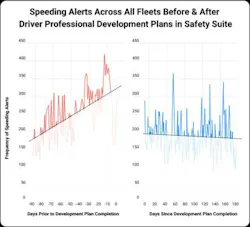
In one analysis of PDP effectiveness, a leading predictive safety solution showed that speeding alerts across fleets rose in the 90 days before plans were completed, then trended downward over the following 180 days (see Figure 1).
 Why fleet safety must move beyond accident reduction claims toward zero preventable crashes
 trucking's top industry issues 2026 thumbnail
The example shows how risk prediction can drive a specific intervention, whose results lead to meaningful long-term change and let managers monitor improvement. Armed with data insights, fleet managers can coach in a way that engages drivers meaningfully, instead of becoming noise, to reduce risky behaviors, strengthen driver relationships, and boost retention.
High stakes
Why have predictive fleet safety programs become virtually non-negotiable in 2026? No one will argue that protecting drivers and the public is the primary objective of a fleet safety program. But for transportation companies that mistakenly think compliance is enough to mitigate risk, the top-line impact can be catastrophic.
In a transportation landscape plagued by skyrocketing fuel costs, driver shortages, and rising vehicle and equipment costs, fleets are watching their profits shrink in real time. While nuclear verdicts (i.e., awards exceeding $10 million) are becoming increasingly commonplace, even the number of cases with verdicts over $1 million is proliferating, increasing by 235% between 2012 and 2019 compared to the six years prior.
Insurance premiums are also continuing to climb each year as claim severity rises 18.6% from 2021 to 2024. This increase outpaced consumer inflation by 5.4 percentage points, even while heavy-duty truck crash rates fell by 2.6% industry-wide.
“Reptile theory,” which focuses the plaintiff’s attack on your overall safety program instead of the facts of the case, remains the main tool in the billboard lawyer’s toolkit to attack fleets. Without a driver safety program that can detect hidden risk and effectively change driver behavior to prevent crashes, fleets open themselves up to massive financial hits.
FMCSA estimates that fatal large truck crashes cost $13.8 million per crash, with non-fatal crashes costing more than $400,000 per incident. In addition, downtime and loss of productivity drain profits, while poor safety performance damages brand reputation and deters new business.
Reaping the rewards
The good news is that predictive, data-driven fleet safety programs reduce accident risk, helping prevent costly court cases and nuclear verdicts. In fact, plaintiff attorneys are now increasingly looking for tangible proof of a proactive fleet safety culture, evaluating whether a fleet can show a pattern of risk identification, coaching, and intervention before an incident occurs.
Insurers are also beginning to reward fleets that can demonstrate a proactive safety culture. Fleets that can show measurable reductions in risky driving behavior through technology, policy, and behavior change are better positioned to secure coverage and negotiate more favorable terms.
As noted by the American Transportation Research Institute (ATRI), “carriers demonstrating consistent year-over-year improvements in safety technology adoption, safe driver hiring and training practices, and crash history can potentially lower their premium costs”—a welcome relief in today’s cost-competitive transportation industry.
Looking down the road
In 2026, nuclear verdict risk, insurance pressure, driver shortages, and regulatory complexity all point to the same conclusion: Reactive safety is no longer enough. As safety becomes a competitive advantage, fleets need a proactive, holistic safety culture focused on early risk identification and purposeful driver development.
With ML, AI, and predictive analytics driving the bus, fleets can reduce crashes, strengthen their insurance position, and protect themselves in litigation—safeguarding drivers and margins moving forward.
About the Author
 Hayden Cardiff
Hayden Cardiff, VP of safety solutions at Descartes, has worked with commercial fleets to improve driver safety, reduce risk, and build coaching programs that help identify and address unsafe driving behaviors before they lead to accidents. His expertise includes fleet safety, driver performance, compliance, and using operational data to help fleets make more informed safety decisions.