EPA 2027 updates: How OEMs plan to roll out new engines next year
Key takeaways
- 2027 OEM split: Daimler Truck North America (DTNA) is the sole major OEM committing 100% to compliant engines (Detroit Gen 6) in January 2027, while Cummins, Paccar, Volvo Group, and International plan different ways to roll out compliant engines.
- The price gap: FTR estimates NCP pass-through fees will add $6,000 to $7,000 per engine, compared to $8,000 to $12,000 for fully compliant EPA 2027 hardware.
- Order board freeze: October Class 8 net orders fell 36% to 45% year-over-year (13,500–15,600 units) as fleets paused capital commitments awaiting final EPA penalty figures.
- Shared regulatory relief: All OEMs back EPA's pending removal of the 10-year/450,000-mile warranty mandate, a delay of extended useful-life rules to 2030, and replacing DEF derates with dashboard warnings.
With model year 2027 production weeks away, the trucking industry has consensus on how to handle the U.S. Environmental Protection Agency’s (EPA’s) looming heavy-duty emissions regulations—at least when it comes to rolling back the most expensive red tape.
Back in October, FleetOwner reviewed major manufacturers' regulatory filings and initial EPA 2027 compliance roadmaps to gauge what fleets should expect for next year's equipment plans. This month, we analyzed every major North American heavy-duty truck and engine maker’s third-quarter earnings report and investor call to see how their strategies—and pricing—are shifting just weeks before model year 2027 production begins.
While the industry is united on those cost-saving measures, 2027 powertrain strategies diverge sharply as manufacturers still face the EPA’s mandate to cut NOx emissions by roughly 83%—down to 35 milligrams per brake horsepower-hour starting January 1, 2027—alongside new low-load cycle standards.
At a glance: 2023 Baseline Rule vs. Proposed 2027 Relief
Unless the EPA finalizes its July 2026 Notice of Proposed Rulemaking (Docket ID EPA-HQ-OAR-2026-0728), the 2023 Clean Trucks Plan takes full effect January 1, 2027. Here is how the proposed rulemaking would change the rules:
- Tailpipe limits: Both frameworks cut NOx limits by roughly 85% to 0.035 g/hp-hr and halve particulate matter to 0.005 g/hp-hr.
- Warranty relief: Cancels the 10-year/450,000-mile mandate, keeping the 5-year/100,000-mile standard to save $4,000 to $6,000+ per truck.
- Useful life delay: Pushes extended full useful-life validation requirements back from 2027 to 2030.
- DEF inducements: Eliminates mandatory speed limits and engine derates, shifting to audible chimes and visual warnings by 2029.
- NCP safety valve: Authorizes per-engine fees—estimated at $6,000 to $7,000—to keep selling higher-emitting engines.
The division centers on the EPA’s proposed non-conformance penalties (NCPs). If finalized, NCPs would serve as a financial safety valve, letting manufacturers pay a per-engine fee to sell legacy 200-mg NOx equipment that falls short of the new, stringent standard. OEMs can also draw on banked emissions credits earned in recent years from selling equipment cleaner than current federal baselines.
Waiting on Washington to finalize NCP prices stalled the fall order season just as 2026 build slots sold out. Preliminary North American Class 8 net orders dropped in October to between 13,500 units (down 45% year over year, according to ACT Research, even as Classes 5–7 rose 14% to 18,000 units) and 15,600 units (down 36% year over year and nearly half the 10-year October average of 31,089, according to FTR Transportation Intelligence).
“While spot rates remain supportive of equipment demand, the lack of clarity around EPA 2027 rules and associated costs has left OEMs and fleets unable to plan for next year,” Carter Vieth, research analyst at ACT Research, said. “It’s not a lack of desire for new equipment holding fleets back, but rather the inability to make informed investment decisions in the face of regulatory and economic uncertainty.”
With the 2026 pre-buy complete and plants near capacity through year-end, OEMs opened 2027 order boards with fluid pricing. FTR estimates that passing through NCPs could add $6,000 to $7,000 per engine for buyers, compared with an $8,000 to $12,000 premium for fully compliant 2027 engines. High fuel, insurance, and labor costs are also pressuring carrier margins and steering near-term capital toward trailers, noted Dan Moyer, FTR senior analyst for commercial vehicles.
“Weak October results suggest that some purchases may be deferred rather than canceled, potentially allowing orders to strengthen as emissions requirements, production schedules, and equipment pricing become clearer,” Moyer said.
Daimler Truck North America (DTNA), the lone OEM against the penalty option, wants customers to know that federal courts vacated NCPs during the 2012 emissions transition, ruling penalties are not meant to bail out manufacturers that choose not to adopt compliant technology.
That split forced North America’s heavy-duty truck and engine makers to choose between two paths for 2027: rely on NCPs and legacy engines to ease the transition, or commit exclusively to compliant hardware. Based on regulatory filings, company statements, and third-quarter executive earnings calls, here is where each manufacturer stands heading into 2027.
How U.S. truck and engine OEMs' EPA27 compliance plans differ
Cummins: Phasing in HELM X15 and X10 while leaning on NCPs
Cummins, the industry’s largest independent engine supplier, plans to lean heavily on legacy platforms, NCPs, and banked emissions credits throughout 2027. In regulatory filings, Cummins noted that its X15 engine spans 17 OEMs and 29 chassis across dozens of applications, and told the EPA it requires a phased production ramp.
During the company’s November 5 Q3 earnings call, CEO Jennifer Rumsey said Cummins expects the EPA to release its final rule—with NCPs included—in December. However, lingering questions over final penalty rates delayed some Q3 purchasing decisions, prompting Cummins to trim its 2026 medium-duty truck market forecast.
“The question and what’s driving some underlying market uncertainty is, will they change the amount of those NCPs from the draft rule,” Rumsey told analysts.
With its Jamestown, New York, X15 plant sold out and running at capacity in Q4, Cummins expects 2027 heavy-duty truck production to remain flattish against 2026’s projected 240,000 to 250,000 units. Executives confirmed the vast majority of Cummins’ 2027 North American truck engine builds will remain on legacy platforms, with NCP fees passed on to customers buying older-spec products.
“We have been working closely with all of our OEM customers around product availability and plans, and we anticipate largely in the next year [that] we’ll sell more of the current products, but we have a phased transition that we’ve announced over the course of the year, launching limited production of X10 and X15 in January and then transitioning in the third and fourth quarter to full production of the new product,” Rumsey said. She added that Cummins will shift fully to the new HELM platforms in early 2028. More than 500 customers and dealers recently tested the 2027 X15, X10, and natural gas X15N during Cummins’ Forever Rising Tour.

DTNA: Rejecting NCPs to go all-in on Detroit Gen 6
Daimler Truck North America (DTNA), parent of Freightliner, Western Star, and Detroit, stands alone in rejecting the NCP pathway. Holding the largest Class 8 market share via Freightliner, DTNA warned regulators that using penalties for economic preference rather than technological limitation invites federal litigation and said it will stick with its compliant Detroit Gen 6 powertrain.
“We believe meeting the EPA 2027 emissions standards is the path forward,” Daniel Potter, DTNA’s head of regulatory affairs for emissions, said during an autumn media briefing. “Buying a Detroit engine and a Freightliner provides you certainty today. We meet the only law that’s on the books today, and that means you can guarantee you will have an engine, and you can guarantee you know what that engine is going to be and what it’s going to cost.”
On Daimler Truck’s Q3 earnings call, CEO Karin Rådström reaffirmed that clean break. Noting that Clean Air Act rules require NCPs to be financially disadvantageous compared to adopting compliant hardware, she called approaching 2027 without knowing exact buyer surcharges on older engines “rather confusing” for the market—but stressed DTNA’s road map is locked in.
“We have a little bit different approach than some others. We will only offer the EPA 27 engine starting from next year,” Rådström told analysts. “We have made the promise, or we see a 3% fuel consumption improvement with that engine, but we are getting really good feedback now from the engines we have out there that it is even better than that. I think we walk into 2027 quite confident, and we will convert fully to the new engine, regardless of what happens with NCPs and other things.”
Addressing potential warranty exposure from the new architecture, Daimler Truck CFO Eva Scherer said Detroit Gen 6 presents no added financial risk: “For us, this is really more an evolution when we go from the Gen 5 to the Gen 6 Detroit Diesel engines. You can say that we have around 80% common parts.” A DTNA spokesperson also noted banked emissions credits remain an established tool that will “complement, not replace, our engineering efforts.”
While Scherer acknowledged some fleets are waiting to see where broader 2027 truck prices land, DTNA’s North American order share hit 35% in Q3 and 33% in October. Furthermore, Scherer noted Q1 2027 build slots are “filling up nicely now, and the fill rate is actually higher than it was a year ago for quarter one in 2026,” allowing DTNA to avoid a major Q1 production downshift as component bottlenecks push some Q4 builds into early 2027.
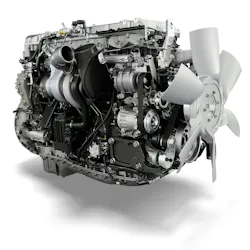
International Motors: Dual-track S13 strategy hits slight Q2 2027 ramp delay
International Motors—rebranded from Navistar under parent company Traton Group—was the first OEM to announce a 2027-compliant platform with its updated S13 Integrated Powertrain, assembling prototypes on the same Huntsville, Alabama, line as current engines. In regulatory filings, International backed NCPs for 2027 while opposing combining them with emissions credits.
On Traton Group’s Q3 earnings call, CEO Christian Levin confirmed International is pursuing a two-path strategy—keeping its EPA 2024 engine available throughout 2027 while phasing in the EPA 2027 S13. While International initially targeted Q1 2027 compliant production, Levin noted minor ramp-up hurdles have pushed initial deliveries back slightly.
“We have a couple of hiccups with the ramp-up. So I guess the first customers will get their EPA 27-compliant engines in the second quarter. But the EPA 24, you can get all along,” Levin said.
With 2026 slots sold out, Levin called Washington’s delay in closing out EPA 2027 rules and NCP costs “extremely frustrating,” noting competing OEM pricing messages have sparked Class 8 buyer hesitation rather than a clear preference between 2024 and 2027 engines. Still, buoyed by improved spot and contract freight rates and data center construction driving vocational demand, Levin expects the 2027 U.S. market “to be at least on this year’s level, but probably higher” once NCP prices stabilize.
Paccar (Kenworth and Peterbilt): Banking on current engines and NCPs
Paccar, parent of Kenworth and Peterbilt, told regulators earlier this year it could not meet the 35-mg threshold by January 2027 because its chosen technology has an immature supply base, positioning NCPs as an essential bridge.
During Paccar’s Q3 earnings call, CEO Preston Feight said customer meetings—including discussions at the American Trucking Associations fall conference—show unanimous fleet interest in sticking with proven 200-mg NOx engines in 2027.
“We made the observation of it’s easier to build trucks when we got parts, and it’s easier to price trucks if you know the cost,” Feight said. “Every customer we meet with is much more interested in proven stable technology that they’ve had time to vet in their operations. And so they’re asking for us to deliver to them trucks with the 200-mg and an NCP because that makes their operations smoother compared to introducing new technology from any manufacturer that they haven’t had enough time with.”
As fleets begin setting 2027 capital budgets, Feight said getting NCP certainty at a manageable cost within four to eight weeks will be key to filling Q1 build slots, particularly as carriers face elevated diesel prices.
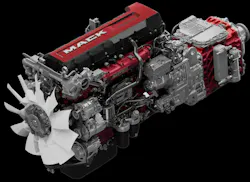
Volvo Group (Volvo and Mack): Offering both EPA 2024 and 2027 D13/MP13 powertrains
Volvo Group, including Mack Trucks and Volvo Trucks North America (VTNA), is offering both compliant 35-mg NOx engines and carryover EPA 2024 options via proposed federal transition provisions. These are the only two truckmakers that have explicitly stated their new technology cuts NOx to 35 mg per hp/hr.
On Volvo Group’s Q3 earnings call, CEO Martin Lundstedt noted the company kept 2027 order books closed through July and August before opening them September 1, remaining selective on backlog lead times.
“The strong thing for us is that we have the offerings in both the categories for 2024 and 2027, and that means that we can provide what the customer wants to have,” Lundstedt said. He added that summer engineering updates allowed Volvo to carry fuel-efficiency improvements—up to 10% on VTNA’s redesigned VNL and EPA27 D13 platform—into its EPA 2024 lineup as well, helping fleets offset high diesel prices.
“Everyone counts now on the fact that you can choose between the two types of regulatory levels and also sort of start counting what it can mean in terms of the, so to speak, extra cost related to the EPA 2024,” Lundstedt told analysts.
VTNA is taking orders for both its EPA 24 D13 and compliant 35-mg EPA 27 D13 engines across VNL and VNR tractors. Mack Trucks is likewise offering a choice across its Granite, Pinnacle, Anthem, and Pioneer models, with deliveries of its 2027-compliant MP13 engine—touted for up to 3% additional fuel savings—slated for late Q1 2027.
About the Author
 Josh Fisher
Editor-in-Chief
Editor-in-Chief Josh Fisher has been with FleetOwner since 2017. He covers everything from modern fleet management to operational efficiency, artificial intelligence, autonomous trucking, alternative fuels and powertrains, regulations, and emerging transportation technology. Based in Maryland, he writes the Lane Shift Ahead column about the changing North American transportation landscape.